


Most B2B ads are just white noise. You spend weeks on a campaign, hit 'launch,' and then... nothing. Silence in the dashboard. But before you blame your designer or fire your agency, look at the bones of your process. Usually, it's not a lack of talent - it's a structural leak that’s draining your budget.
These mistakes are not subjective. They are diagnosable. Each one has a specific symptom in the performance data, a specific cause in the production process, and a specific operational fix. This article walks through all seven, with a diagnostic question for each, so you can self-identify which ones apply to your current creative.
THE 7 MISTAKES
(1) Generic messaging | (2) Ignoring platform formats | (3) No testing cadence | (4) Inconsistent brand | (5) Weak CTA strategy | (6) Poor hooks | (7) Ignoring performance data
Every one is structural. Every one is fixable. None requires better creative talent.
Mistake #1: Generic Messaging with No ICP Specificity
Generic messaging is the most common B2B creative failure, and the most invisible to the people producing it. “Scale your marketing operations.” “Streamline your creative workflow.” “Grow faster with better content.” These claims are technically accurate and functionally invisible. They describe the benefit without describing the specific person who has the problem. In the B2B world, 'generic' is just a fancy word for 'expensive invisible ink'.
Diagnostic question: Read your current ad headline or LinkedIn post hook out loud. If it could be published by three of your competitors without anyone noticing, it’s generic.
The fix: Add one specific qualifier that makes the message relevant to exactly one type of person. Not “scale your marketing operations” but “for CMOs managing 15+ assets per month without a sprint system.” Specificity is not exclusion - it’s qualification. The people who are not CMOs managing 15+ assets per month will self-select out. The ones who are will stop scrolling.
Mistake #2: Ignoring Platform Format Requirements
B2B marketers routinely take LinkedIn creative and resize it for Meta. Or take a 16:9 video and post it vertically on Instagram. Or write 150-word ad copy for a platform where 25 words is the visible limit. Each of these mistakes signals to the platform’s algorithm that the content is not native - which reduces distribution and increases CPL. Posting a LinkedIn banner on Instagram is like wearing a tuxedo to a beach party. You might look expensive, but you clearly don’t belong here, and everyone can feel the awkwardness.
Diagnostic question: Was each piece of your current creative briefed and produced specifically for the platform it runs on, or was it adapted from another format?
The fix: Build platform-specific creative requirements into the master brief template. For each asset in a sprint, the brief specifies: platform, placement (feed, story, banner), dimensions, maximum copy length, and the platform’s dominant content context (professional/work mode for LinkedIn; entertainment/scroll mode for Meta). Creative briefed to platform-specific requirements performs 30 - 50% better than resized cross-platform creative.
Mistake #3: No Testing Cadence
Running the same ad for two months and 'hoping' it eventually clicks is like shouting at a brick wall and waiting for it to answer. Hope is a beautiful thing, but in performance marketing, it’s just a fast way to burn money. If you don't have a weekly testing rhythm, you’re not marketing - you’re gambling. Performance plateaus, then declines as creative fatigues, and the team replaces it with new creative that is similarly unoptimized.

Diagnostic question: Can you name the specific creative hypothesis you are testing this week, and the metric that will tell you whether it was validated?
The fix: Implement a sprint cadence: new creative variants every 7 - 14 days, each testing one specific variable (hook, angle, format, or offer) against the current control. Document the hypothesis before production begins. Review performance at the end of the test window. Apply learning to the next brief. At a minimum: 3 - 5 variants per sprint, reviewed weekly.
Mistake #4: Inconsistent Brand Across Touchpoints
A prospect who sees your LinkedIn post on Monday, your Meta ad on Wednesday, and your email on Friday encounters three different visual languages, three different tonal registers, and three different positioning angles. The brand impression is fragmented. Fragmented impressions don’t build trust - they create cognitive friction that prevents brand recognition from forming.
Diagnostic question: If you placed your current LinkedIn post, Meta ad, and email header side by side with no logos, would someone recognize them as coming from the same brand?
The fix: Produce all channel creative in the same sprint, from the same master brief, by the same production team. Synchronized sprint production is the most reliable mechanism for cross-channel brand consistency - because all assets share the same brief, the same creative direction, and the same production context. A brand standards document helps; a synchronized sprint makes it automatic.
Mistake #5: Weak or Absent CTA Strategy
The most common CTA mistake in B2B creative: “Learn More” on everything. Learn More' is the creative equivalent of 'How are you?' - everyone says it, but nobody really listens. It’s the safest, blandest button in existence.
If your CTA doesn't tell the prospect exactly what's behind the door, don't be surprised when they don't bother to knock.
Diagnostic question: Read your current CTA. Does it tell the prospect specifically what they will receive when they click, in 5 words or fewer?
The fix: Match CTA specificity to audience temperature. Cold traffic (first exposure): low-commitment, high-value CTA (“See How It Works,” “Get the Framework”). Warm retargeting (prior brand exposure): medium-commitment CTA (“Book a 20-Minute Call,” “Start a $500 Trial”). High-intent (visited pricing page): high-commitment CTA (“Book a Demo,” “Start Free Trial”). A mismatch between audience temperature and CTA commitment level - asking cold traffic for a demo booking - is one of the most common CTR killers in B2B paid advertising.
Mistake #6: Poor Hooks That Fail to Stop the Scroll
The hook is the first 1.7 seconds of a Meta video, the first line of a LinkedIn post, or the headline of a static ad. It is the single highest-leverage element in any piece of B2B creative - and the most commonly under-invested. Your hook has exactly 1.7 seconds to win. In that tiny window, you’re fighting against a trillion-dollar dopamine machine (the scroll). If your hook doesn't grab them by the throat, you’re invisible.
A strong creative with a weak hook will be scrolled past before anyone reads it. A mediocre creative with a strong hook will generate more engagement than the strong creative simply because the hook earned the attention.
Diagnostic question: Does your current creative’s hook create an immediate, specific reason for your ICP to stop scrolling? Or does it open with your company name, a generic benefit, or a question anyone could ask?
The fix: Use one of four proven hook structures for B2B: (1) Counterintuitive claim (“Your $800 freelancer costs $4,500/month”), (2) Specific data point (“73% of B2B creative campaigns fail for the same 3 reasons”), (3) Diagnosis (“If your CPL hasn’t moved in 90 days, here’s why”), (4) Contrast (“Company A: $145 CPL. Company B: $82 CPL. Same budget. Same ICP. Different creative architecture.”). All four are specific, ICP-relevant, and create a reason to read on.
Mistake #7: Ignoring Performance Data
The most expensive B2B creative mistake is not any single poor-performing ad. It is the absence of a structured review process that converts performance data into the next brief. Companies that produce creative without reviewing what it produced - and adjusting accordingly - repeat the same mistakes indefinitely.
The creative may change in style, the structural failures persist. Let’s get real for a moment: when was the last time your creative brief started with a data insight rather than a 'gut feeling' or a deadline panic?
Diagnostic question: In your last three creative sprints, how many of the creative decisions were directly informed by performance data from the previous sprint?
The fix: Implement a sprint data review: at the end of each sprint (7 - 14 days after launch), review hook rate, CTR, CPL, and lead-to-demo rate by asset variant. Identify the highest-performing angle and format. Document in the Learning Log.
Use the Learning Log as the primary input for the next sprint’s brief. The brief should not be written from scratch - it should be written as a refinement of what the previous sprint validated.
The Meta-Solution: Why Systematic Production Prevents All Seven
Reading through the seven mistakes, a pattern is visible: six of the seven are prevented by a functioning sprint-cadenced production system.
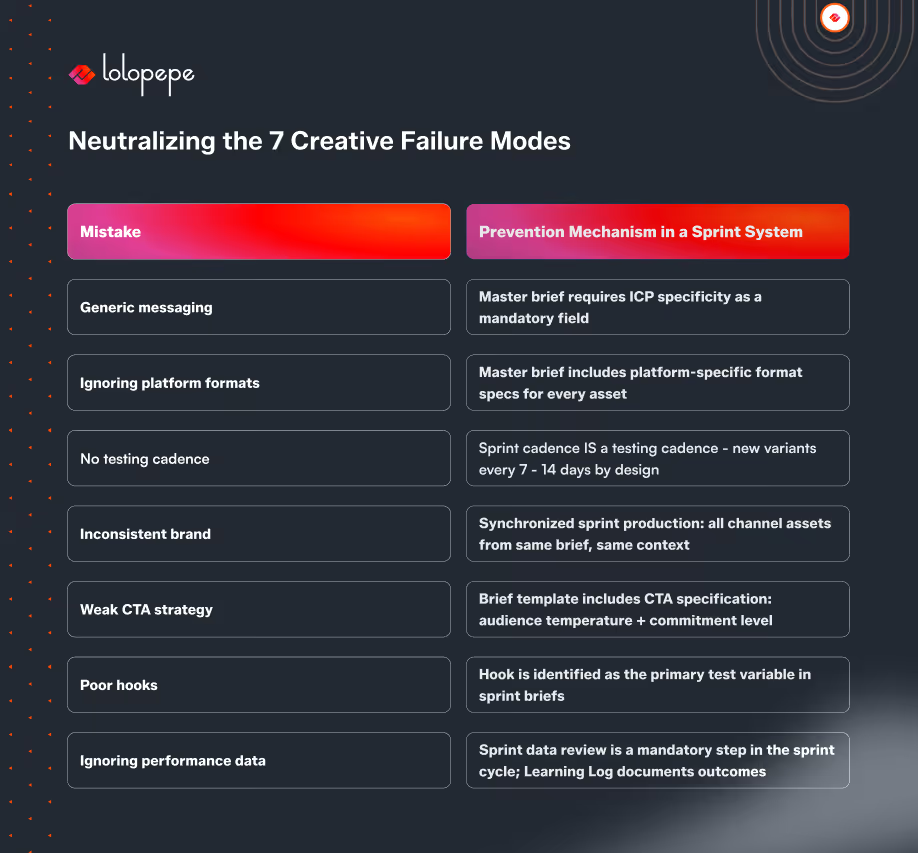
The sprint system does not guarantee great creativity. It guarantees that the structural conditions for great creativity are present: specific briefs, platform-appropriate production, consistent testing cadence, synchronized channel production, CTA strategy, hypothesis-driven hook development, and mandatory performance review.
Frequently Asked Questions
Q: Which of the 7 mistakes has the highest impact on CPL?
A: Poor hooks (Mistake #6) and no testing cadence (Mistake #3) have the highest direct CPL impact. Poor hooks prevent the creative from generating the click regardless of everything else. No testing cadence prevents CPL from improving over time. Fixing both simultaneously - implementing a sprint cadence with hook as the primary test variable - typically produces the fastest CPL movement, with meaningful improvement measurable within 30 days.
Q: Can we fix all 7 simultaneously or should we prioritize?
A: Fix the testing cadence first (Mistake #3) and the data review process (Mistake #7) together - these are the meta-fixes that accelerate correction of the other five. Once you have a sprint system with a structured data review, you can identify and prioritize the remaining mistakes based on what the data shows. Without a testing cadence, fixing the other mistakes is a one-time improvement that fades as creative fatigues without iteration.
Q: How do we know which mistake is the primary driver of our current underperformance?
A: Use the diagnostic questions in each section above. Apply them to your current live creative. The ones that produce a negative answer are your active failure modes. For performance data: if CPL is high but CTR is reasonable, the problem is post-click (landing page, offer, or lead quality from Mistake #1). If CTR is low, the problem is pre-click (hook, Mistake #6, or platform format, Mistake #2). If lead volume is adequate but pipeline quality is poor, the problem is ICP specificity (Mistake #1) or CTA temperature mismatch (Mistake #5).
Q: Does fixing these mistakes require a complete creative overhaul?
A: No - and attempting a complete overhaul is often the wrong approach. Fix one variable at a time, in a structured test. If you suspect Mistake #6 (poor hooks), produce 3 - 5 new variants with different hook structures, keeping everything else constant. Run them against your current creative for 7 days.
Let the data tell you which hook structure works for your specific ICP. This is more reliable than a complete creative overhaul, and it builds the Learning Log that makes future sprints better.
The Bottom Line
B2B creative failure is usually not a talent problem. It’s a systemic problem. When campaigns fail, most teams blame the outcome. The headline. The concept. The agency. The designer. The real problem starts long before the creative is created. Because the biggest killers of B2B creativity are structural errors.
The seven errors in this article are structural - they’re built into the production process, not the creative output. They can be diagnosed with specific questions and fixed with specific operational changes.
Most of them are also preventable: A sprint-paced production system with a mandatory brief template, synchronized production channels, and a structured data review cycle eliminates six of the seven as structural opportunities rather than managing them as recurring problems. Every one of these errors is preventable. None of them require better creative talent. They require a better creative process.
Download the B2B Creative Audit Checklist - a one-page diagnostic tool covering all 7 failure modes with the diagnostic question and fix for each.
Book a Creative Audit (Trial) for $750
Or get a Free Creative Audit: send us your current live creative and we’ll identify which of the 7 mistakes are actively limiting your results.

Mirhayot Yunusov
Co-Founder at Eloqwnt | LoloPepe
Mirhayot builds design-led ventures that make impact. He specializes in turning subjective intuition into scalable Brand Operating Systems that empower Series A+ companies to ship daily.
Through his articles, Mirhayot shares the design thinking, strategic frameworks, and creative decisions behind building brands that look and feel like leaders. Whether it's brand systems, web design, or motion his insights are built from real work with real companies.
Subscribe to our newsletter.
Get valuable strategy, culture, and brand insights straight to your inbox.