

How to Build a Creative Brief That Actually Works: The B2B Marketer’s Template
Most creative briefs are just expensive invitations to a 12- hour revision hell. If your current process feels like throwing paper airplanes into a storm, here is the 7- section map that finally forces your data and design to speak the same language.

Mirhayot Yunusov
Co-Founder at Eloqwnt | LoloPepe

The designer opened the brief on a Monday morning. It read: “We need an ad for our new feature launch. Make it look premium. Due Friday.”
She had no idea who the ad was for. No idea what platform it was running on. No idea what the feature did or why anyone should care. No idea what “premium” meant to this company. No idea what success looked like. The brief told her a deadline and a vibe. Nothing else.
By Friday, everyone is exhausted. The ad looks like a Frankenstein of three different ideas, and the designer is likely looking at their resignation letter. All because the brief was a 'vibe' rather than a map.
This is not a story about a difficult designer or a demanding stakeholder. It is a story about a failed brief. And a failed brief is not a writing quality problem. It is a structural omission problem. The brief was missing the sections that would have made independent creative decision-making possible.
THE 7-SECTION BRIEF
(1) Context | (2) Objectives | (3) Audience | (4) Message | (5) Constraints | (6) What This Is Not | (7) Success Metrics
Missing any section increases revision cycles by 40 - 60%. A brief that takes 2 - 3 hours to write saves 8 - 12 hours in revision cycles.
Why Most Briefs Fail: The 5 Structural Omissions
Most briefs fail for the same structural reasons. They are not bad because the requester didn’t try hard enough. They are bad because they are missing specific information that creatives need to make decisions without asking for clarification.
Omission 1: No audience definition. “Our target customer” is not an audience definition. A specific ICP description - role, company size, active problem, emotional state at the moment of encounter - is what enables a creative to write a hook that stops the scroll for exactly that person.
Omission 2: No single core message. Briefs that list six key points produce creative that tries to communicate six things and communicates none of them clearly. One brief, one message. The supporting proof points exist to substantiate the core message, not to compete with it.
Omission 3: No format specifications. “An ad” is not a format specification. Sending a brief without format specs is like ordering a custom-made suit but refusing to give the tailor your measurements. You'll get a suit, sure, but it won't be yours. Platform, placement, dimensions, video length... are not optional fields.
Platform, placement, dimensions, video length, maximum copy length, and file format requirements are not optional fields. A designer who produces a 1200×628 static for a placement that displays at 1080×1080 has not made a creative error. The brief made an omission error.
Omission 4: No revision scope. Without a defined revision scope (one round, two rounds, specific criteria), revisions are open-ended. Every open-ended revision process expands to fill the time available.
Omission 5: No explicit exclusions. The most commonly omitted section in every brief template on the internet. “What This Is Not” - a list of directions, tones, references, or approaches the creative should explicitly avoid - eliminates the most common wrong-direction deliverable before production begins. It takes 5 minutes to write and prevents 3-hour revision rounds.
Audit your last 30 days: how many hours did your team lose just because the brief didn't explicitly say 'no UI screenshots' or 'avoid corporate jargon'?
The 7-Section Brief Template
Each section is required. The sections are sequenced deliberately: context before objectives (so the creative understands why before they understand what), audience before message (so the message is written for the right person), constraints before success metrics (so the creative knows what they’re working within before they know how they’ll be evaluated).
Section 1: Context
What to include: The business situation that requires this asset. What is happening in the company, campaign, or market that makes this asset necessary right now? Context is the 'why' that keeps your team from flying blind. It’s the difference between asking someone to 'paint a wall' and telling them 'we’re preparing the nursery for a new arrival.
Why it matters: Creatives make dozens of small decisions during production. A designer who knows that this ad is running during a competitive product launch in a market where the brand has low awareness will make different decisions than one producing a generic acquisition ad. Context enables better small decisions.
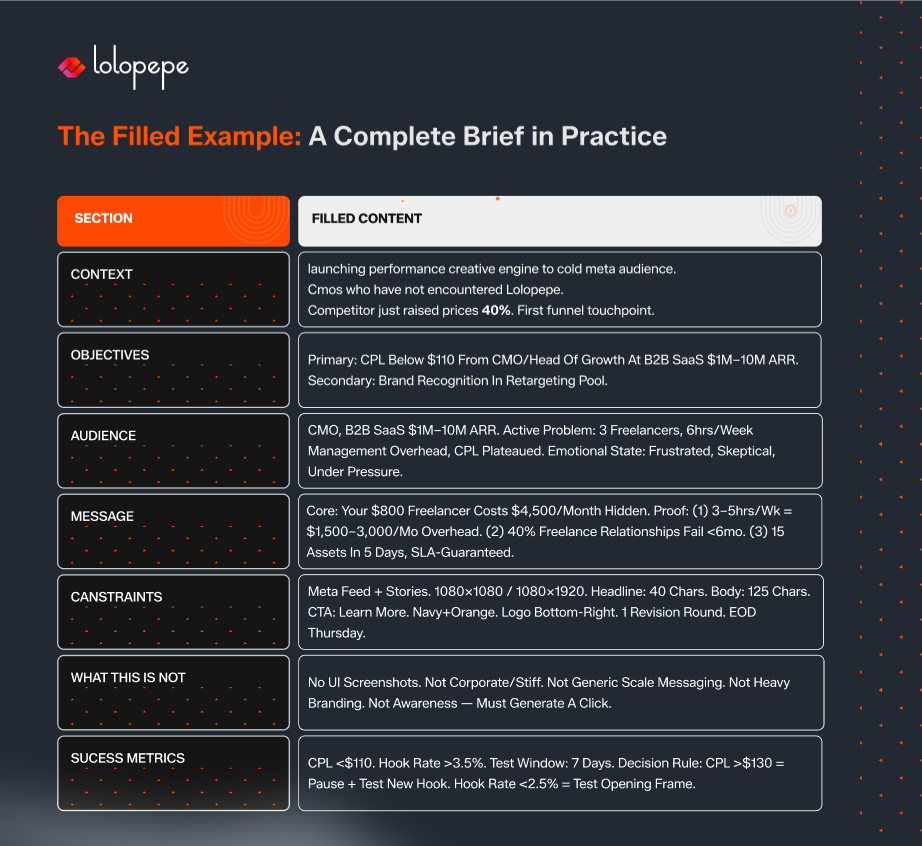
Filled example: “We are launching our Performance Creative Engine retainer to a cold Meta audience of B2B SaaS CMOs. These are people who have not encountered LoloPepe before. Our primary competitor just raised their prices by 40%. The ad is the first touchpoint in the funnel.”
Section 2: Objectives
What to include: The specific, measurable outcome this asset must produce. Not “increase brand awareness” - that is unmeasurable. “Generate qualified leads (CMO at $1M–10M ARR B2B SaaS) at a CPL below $110” is an objective.
Why it matters: An objective-less brief produces creative that looks good in isolation but may not achieve the business purpose. It is like throwing a paper airplane into a storm. It moves, it flies, but it has no say in where it lands. A designer who knows the objective is CPL below $110 will prioritize conversion elements over brand aesthetics, and who knows the objective is brand authority will make the opposite prioritization.
Filled example: “Primary objective: Generate leads (CMO/Head of Growth at B2B SaaS $1M–10M ARR) at CPL below $110. Secondary objective: Build brand recognition among the retargeting audience for future conversion.
Section 3: Audience
What to include: A specific persona description covering: role, company profile, the active problem they are experiencing right now, and their emotional state at the moment they encounter this creative.
Forget LinkedIn job titles for a second. Think about the person sitting behind the screen at 11 PM, frustrated that their current solution is leaking money. That’s the person you’re talking to, not a 'Persona B'.
Why it matters: The hook, the tone, and the proof points are all determined by the audience’s active problem and emotional state.
“CMOs at B2B SaaS companies” is not specific enough to write a hook. “A CMO managing three freelancers, spending 6 hours per week on creative management, and watching her CPL rise while her capacity is maxed out” is specific enough to write a scroll-stopping hook.
Filled example: “Role: CMO or Head of Growth. Company: B2B SaaS, $1M–10M ARR, 10 - 50 employees. Active problem: Managing 2 - 3 freelancers for ad creative, spending 5 - 8 hours/week on briefing and revision management, CPL has plateaued or risen in the last 90 days. Emotional state: Frustrated with the management overhead, skeptical that there’s a better model, under pressure from leadership to improve pipeline.”

Section 4: Message
What to include: One core message - the single claim the asset must communicate - plus 2 - 3 supporting proof points. The core message should be expressed as a complete sentence, not a tagline. The proof points should be specific data, outcomes, or comparisons, not general benefits.
Why it matters: A brief with multiple “key messages” produces creative with multiple competing claims. The hierarchy is non-negotiable: one core message, supported by proof. Everything else is noise.
Filled example: Core message: “Your $800 freelancer is costing you $4,500/month in hidden management overhead - a productized sprint model costs less and produces more.” Proof points: 1. 3 - 5 hours/week of senior marketer time on freelancer management = $1,500 - 3,000/month in hidden cost. 2. 40% of freelance relationships break down within 6 months, triggering re-onboarding cycles.
Section 5: Constraints
What to include: Platform, placement, dimensions, video length (if applicable), maximum copy length (headline, body, CTA), file format requirements, brand elements that must appear, revision rounds included, and hard deadline.
Why it matters: Constraints are not limitations on creativity - they are the parameters within which creative decisions are made. A designer working without format specifications is making format decisions that may need to be reversed.
Filled example: “Platform: Meta (Facebook + Instagram). Placement: Feed (primary), Stories (secondary). Dimensions: 1080×1080 feed, 1080×1920 stories. Max headline: 40 characters. Max body copy: 125 characters. CTA button: ‘Learn More’ or ‘Get Started’. Brand: LoloPepe navy (#002b5c) and orange (#FF8559) must appear. Logo in bottom-right corner. Revisions: 1 round. Deadline: EOD Thursday.”
Section 6: What This Is Not
What to include: Explicit exclusions - directions, tones, references, formats, or visual approaches the creative should not take. Include at least 3 - 5 specific exclusions. Think about the most common wrong-direction deliverables you have received and exclude them explicitly.
Why it matters: Creatives are human - they have muscle memory. If you don't tell them what not to do, they’ll subconsciously retreat to the safest, most familiar path. Exclusions are the guardrails that keep them creative. Without explicit exclusions, a designer will produce what they have produced before for similar briefs. The most common wrong-direction outcomes: too corporate/formal for the platform context, too feature-focused when the brief calls for problem-focused, too literal when the brief calls for conceptual. Naming these explicitly prevents them.
Filled example: “This is NOT: a product feature showcase (no UI screenshots). NOT corporate or stiff in tone — this should feel like one marketer talking to another. NOT a generic ‘scale your business’ message. NOT heavy on LoloPepe branding in the visual - the message leads, the brand follows. NOT a soft awareness play - this ad should generate a click.”
Section 7: Success Metrics
What to include: The specific metrics and thresholds by which this asset will be evaluated. Include: the primary KPI (CPL, hook rate, lead volume), the target threshold, the test window, and the decision rule (“if CPL is above $130 after 7 days, this variant is paused”).
Why it matters: Success metrics defined in the brief prevent post-hoc performance debates. “It didn’t perform” is not an actionable evaluation. “Hook rate was 2.1% against a 3% benchmark; CPL was $142 against a $110 target” is actionable. It tells you exactly what to change in the next brief.
Filled example: “Primary KPI: CPL below $110. Secondary KPI: Hook rate above 3.5% (cold audience). Test window: 7 days from launch. Decision rule: If CPL above $130 after 7 days, variant is paused and hook is identified as primary test variable for next sprint. If hook rate below 2.5%, opening frame is the next test variable.”
The Filled Example: A Complete Brief in Practice
Frequently Asked Questions
Q: How long should a complete creative brief take to write?
A: An experienced writer spends 45–90 minutes on a standard brief. But don’t compare that to the "zero minutes" it takes to send a "make it look cool" email. Compare it to the 12-hour revision hell that inevitably follows a bad start. A brief isn’t bureaucracy. It’s an insurance policy against your team’s burnout.
Q: Should the same brief template be used for organic content and paid creative?
A: The same 7-section structure applies to both, with adaptations in the Constraints and Success Metrics sections. Organic content briefs: constraints include platform character limits, posting format (carousel, text post, long-form), and scheduling window. Success metrics for organic: engagement rate target, share volume benchmark, inbound DM rate as a downstream indicator. The Audience and Message sections are identical in structure regardless of paid or organic.
Q: How do you brief multiple assets in a sprint without writing a separate brief for each?
A: Use a Master Brief. Instead of separate documents for every banner, write one shared context and set of objectives, then list the specific formats in a compact Asset Manifest table. One "shared brain" for the entire sprint is faster and more logical.
Q: What happens when a stakeholder changes the brief mid-production?
A: This is the ultimate killer of budgets and deadlines. Your line of defense is the "Brief Lock". It’s an ironclad rule: once the brief is signed, any changes turn into a new revision round or a separate task for the next sprint. Make this a rule of the game, and the chaos stops.
The Bottom Line
A brief isn’t bureaucratic noise. It is your team’s armor against burnout and wasted resources. Ninety minutes of focus today saves twelve hours of frantic revisions tomorrow. Each of the seven sections acts as a fail-safe: Context cures "purpose-blind" creative, Objectives rein in excessive aesthetics, and explicit Exclusions block wrong-direction production before it even starts.
A complete brief isn’t a magic guarantee of genius, but it creates the sterile conditions necessary for it to emerge. It is a written agreement on what victory looks like, signed before a single designer even opens Figma. Give your creatives a map, not a collection of vague intuitions.
Download the Complete B2B Creative Brief Template. Or start your $750 Trial Sprint today - we’ll build your high-velocity creative engine in 7 days.
Copy it into Notion, Google Docs, or your project management system. Use it for every brief from the next sprint forward.
Mirhayot Yunusov
Co-Founder at Eloqwnt | LoloPepe
Mirhayot builds design-led ventures that make impact. He specializes in turning subjective intuition into scalable Brand Operating Systems that empower Series A+ companies to ship daily.
Through his articles, Mirhayot shares the design thinking, strategic frameworks, and creative decisions behind building brands that look and feel like leaders. Whether it's brand systems, web design, or motion his insights are built from real work with real companies.
Subscribe to our newsletter.
Get valuable strategy, culture, and brand insights straight to your inbox.