

SLA in Creative Services: What "Predictable Delivery" Actually Means
A delivery promise without an escalation protocol is just Tuesday in the creative world. We replace institutional friction with timestamped accountability to ensure your predictable results are signed into the contract.

Mirhayot Yunusov
Co-Founder at Eloqwnt | LoloPepe

We’ve all seen this movie: the campaign launch is set for the 1st, but your assets are still 'in progress' on the 14th. You’re left explaining the delay to the board while the agency gives you the classic: 'We’re facing internal bandwidth constraints. The marketing ops manager filed it away as a lesson. Next time she evaluates a creative vendo, she’ll ask about turnaround time. The agency will say “typically two weeks.” She’ll nod. The same thing will happen again.
The issue is not the question she’s asking. It’s the answer she’s accepting. "Typically two weeks" is nothing more than a good intention with zero accountability. A real SLA differs from a promise the same way a rock-solid contract differs from the phrase "I’ll do my best."
SLA DEFINED
A creative services SLA (Service Level Agreement) is a contractual commitment covering three elements: delivery timeline (the specific number of days from brief approval to asset delivery), revision scope (the defined number of revision rounds included in the agreement), and escalation protocol (the defined remedy if the SLA is not met). A genuine SLA is measurable and enforceable - not a marketing claim about being ‘fast’ or ‘responsive.’
What an SLA Actually Is (and Isn’t)
An SLA is a contractual document, not a marketing claim. It specifies, in measurable terms, what the service provider commits to delivering, by when, and what happens if they don’t. In software development and IT services, SLAs are standard. In creative services, they are rare - which is why missed deadlines are so common.
Ask yourself: Are you buying a creative result, or are you just paying for an agency’s best intentions?
What an SLA is not:
- “We typically deliver within two weeks” - this is an estimate, not a commitment
- “We’re very responsive and prioritize our clients” - this is a marketing claim, not a measurable standard
- “Our standard turnaround is 5 - 7 business days” - this is a guideline. Without an enforcement mechanism it is aspirational
What an SLA is:
- “Assets delivered within 5 business days of brief approval. If missed, the next sprint is provided at 50% of standard rate.” - this is a contractual commitment with a defined remedy
- “Brief approved Monday by 12pm CT, assets delivered by Friday 5pm CT, one revision round included, completed within 2 business days of revision brief submission.” - this is an operational SLA with specific parameters.
The distinction is enforceability. An SLA without a defined consequence for non-compliance is not an SLA - it is a stated preference with the word “SLA” attached.
The Three Components of a Real Creative SLA
A real SLA is a contractual engine, not a marketing promise - and it’s built on these three non-negotiable pillars:
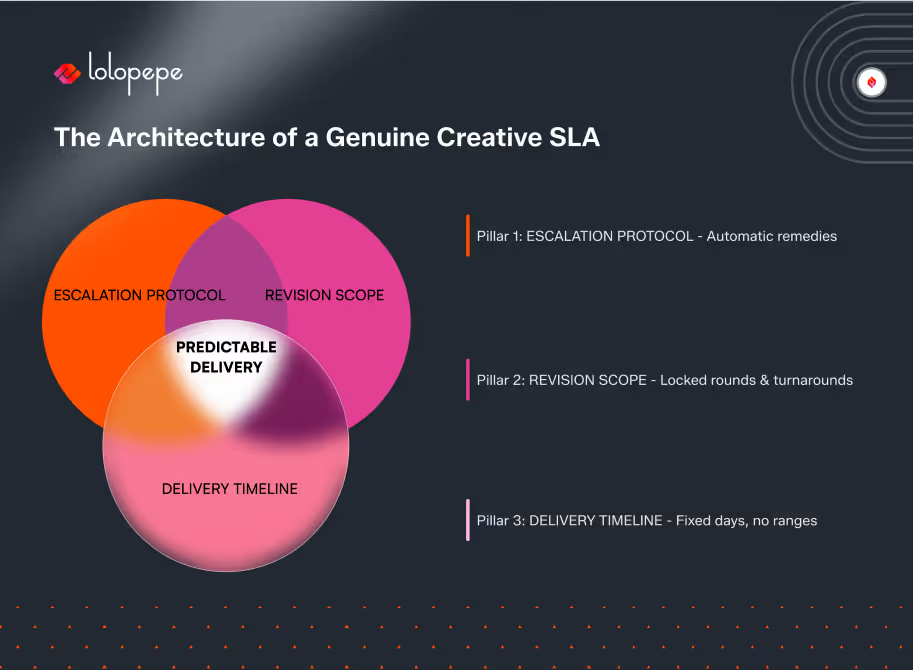
Delivery Timeline. The specific number of calendar or business days from brief approval to asset delivery. Expressed as a fixed commitment, not a range. “5 business days” is a timeline. “5 - 7 business days” is a range that defaults to 7 whenever there is friction. A genuine delivery SLA specifies the maximum, not the typical.
Revision Scope. The defined number of revision rounds included in the agreement, the timeline for revision completion, and the definition of what constitutes a revision versus a new brief.
Without defined revision scope, the delivery SLA is vulnerable to infinite extension - without a locked revision scope, your '5 - day delivery' can easily turn into a 3-week hostage situation where the finish line keeps moving further away.
Escalation Protocol. The defined remedy when the SLA is not met. This is what makes the SLA contractual rather than aspirational. Typical structures: credit toward the next invoice, complimentary sprint, or rate reduction for the period of non-compliance. The specific remedy matters less than its existence.
Example SLA: What It Looks Like in Practice
This isn't a list of "best efforts" - it is a hard-coded operational framework designed to replace vague agency promises with objective, timestamped accountability.
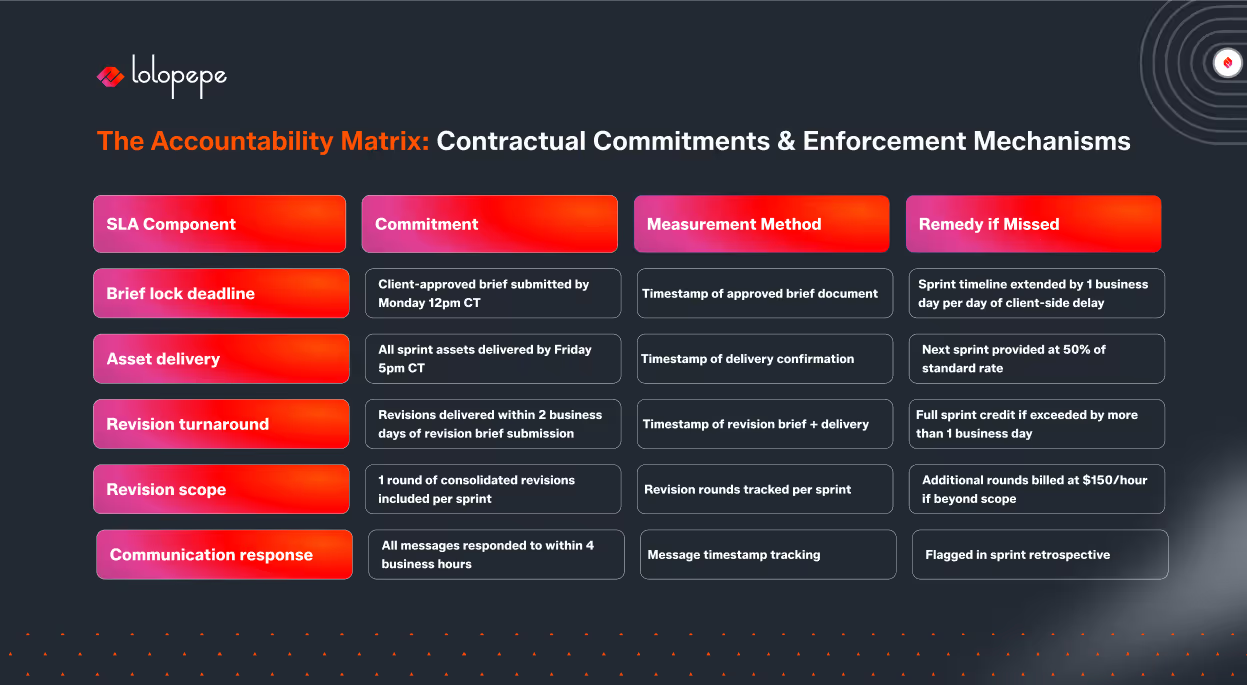
Every commitment above is measurable. Every commitment has a defined remedy. There is no ambiguity about whether the SLA was met.
Agency Timelines vs SLA Timelines: Why the Gap Is Structural
Speed in creative delivery is about removing the institutional friction that keeps projects in limbo. The following breakdown reveals why the traditional agency model is structurally incapable of matching the velocity of a productized system.
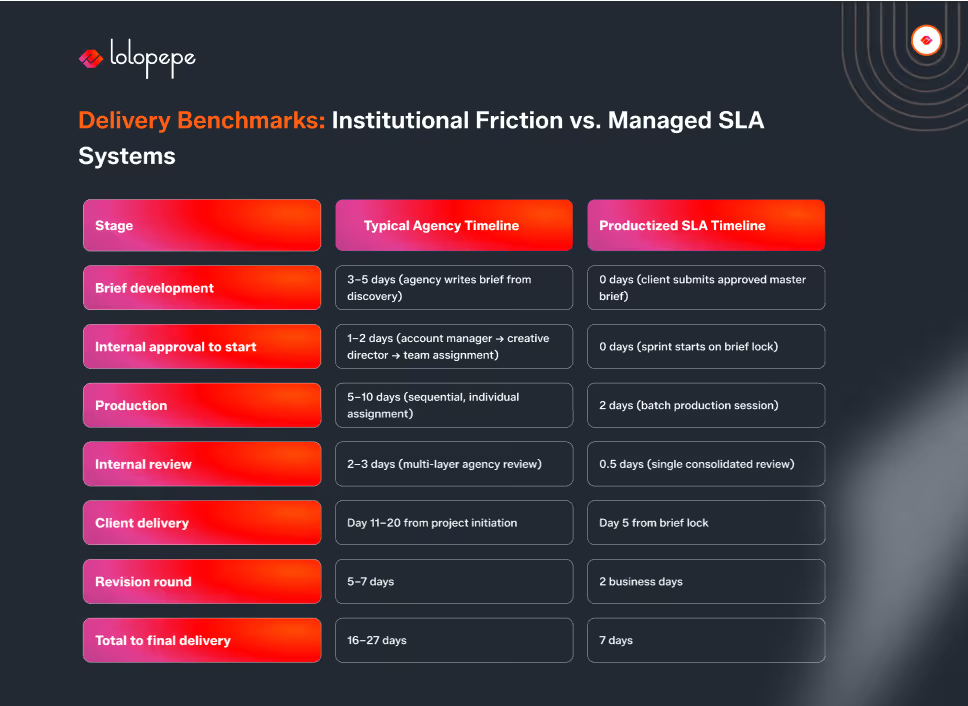
An agency promise without an SLA is like a flight 'estimated ' to arrive at 5 PM, but with no refund if you land at midnight. In aviation, that’s a crisis. In creative services, for some reason, it’s just Tuesday.
The agency timeline is not slow because agencies are inefficient. It is slow because the agency model has structural handoff points - account management layers, internal creative director reviews, multi-stakeholder approval chains - that add calendar time regardless of production speed. The productized model eliminates most of these handoffs by design.
How to Evaluate Any Vendor’s Delivery Claims?
Five questions to ask any creative vendor before signing:
- Is the delivery timeline expressed as a fixed commitment or a range? A range is not an SLA.
- What starts the delivery clock? “From project kickoff” is vague. “From brief approval” is specific and measurable.
- What is the defined revision scope? How many rounds? What is the turnaround time? Is there a charge for revisions beyond scope?
- What happens if the timeline is missed? If the vendor cannot answer specifically, there is no enforcement mechanism.
- Is the SLA in the contract? A verbal commitment is not an SLA. The delivery commitment must be in the written agreement to be enforceable.
A vendor who answers all five specifically and in writing has an SLA. A vendor who answers with qualifications, ranges, or “we’ll do our best” does not.
What Happens When an SLA Is Missed?
The escalation protocol converts an SLA from a preference to a contractual obligation. Its purpose is not primarily punitive - it is calibrating. The existence of a defined remedy creates an operational incentive for the vendor to meet the commitment.
Credit-based: A defined credit (percentage of the next invoice or a fixed dollar amount) is applied automatically when the SLA is missed. Straightforward to implement.
Complimentary sprint: If the delivery SLA is missed, the next sprint is provided at no charge. More significant than a credit for high-value missed deadlines.
Rate adjustment: The rate for the period of non-compliance is reduced proportionally. More complex but directly ties compensation to performance.
The most important attribute of any escalation protocol: it should apply automatically when the SLA is missed, without requiring the client to invoke it. An SLA that requires the client to complain to activate the remedy is not operationally effective.
Frequently Asked Questions
Q: Can I negotiate SLA terms with a creative vendor?
A: Yes - and you should. Any vendor with a genuine SLA framework will be willing to discuss specific terms, timelines, and remedies. Resistance to SLA negotiation is a signal: a vendor who will not commit to specific delivery timelines in writing does not have confidence in their delivery consistency. Negotiable components include the delivery timeline, the revision scope, and the escalation remedy.
Q: What’s a reasonable delivery SLA for B2B ad creative?
A: For a standard batch sprint of 10 - 15 assets: 5 business days from brief approval to asset delivery is achievable and should be the benchmark. For complex productions involving custom photography, video, or motion graphics: 7 - 10 business days is reasonable. Any vendor promising “24 - 48 hours” for a standard sprint without a template system is either compromising quality or overselling their capacity.
Q: How does SLA enforcement work on a monthly retainer?
A: Monthly retainers with sprint cadences should have SLA terms applied per sprint, not per month. A month with four sprints should have four separate SLA measurement periods. An agency that misses two of four sprints but delivers the month’s total asset count within the month technically “delivered” but violated the sprint-level SLA twice. Per-sprint measurement prevents this kind of averaging that masks consistent delivery failures.
Q: Should we require an SLA for freelancers too?
A: You can request one - but enforceability is limited by the structural reality of the freelance model. A freelancer is a single person with variable availability. SLAs are most meaningful with vendors who have operational redundancy - a team that can absorb capacity fluctuations without missing commitments. This is one of the structural reasons productized services maintain SLA compliance more reliably than individual freelancers.
The Bottom Line
Let's be honest: 'Fast turnaround' is what you say on a first date. An SLA is what you sign when you're moving in together.
The difference between a delivery promise and an SLA is enforceability. Promises are made in sales conversations. SLAs are written into contracts, measured objectively, and carry defined consequences when missed.
Most creative vendors make delivery promises. Very few make delivery commitments. The distinction is visible in exactly one place: the contract. If the delivery timeline, revision scope, and escalation protocol are not in writing, you have a promise. If they are, you have an SLA.
Evaluating vendors by this standard eliminates a large number of delivery disappointments before they happen.
Download the Creative Vendor SLA Checklist - five questions to ask any creative vendor before signing, with the specific answers that indicate a genuine SLA vs a delivery promise.
Tired of chasing ghosts? Book a Brand Content Audit (Trial) for $750. Let’s build your first month’s content slate and prove that 'predictable' isn't just a buzzword in our contract.
Mirhayot Yunusov
Co-Founder at Eloqwnt | LoloPepe
Mirhayot builds design-led ventures that make impact. He specializes in turning subjective intuition into scalable Brand Operating Systems that empower Series A+ companies to ship daily.
Through his articles, Mirhayot shares the design thinking, strategic frameworks, and creative decisions behind building brands that look and feel like leaders. Whether it's brand systems, web design, or motion his insights are built from real work with real companies.
Subscribe to our newsletter.
Get valuable strategy, culture, and brand insights straight to your inbox.