

The Real Cost of ‘Cheap’ Creative: A CAC Analysis for B2B SaaS Companies
Your $800 freelancer is likely costing you $5,000 once you calculate the "invisible tax" of management friction and delayed launches. We dismantle the sticker-price illusion with a cold-blooded TCO analysis. Discover how engineering your creative ops can turn a perceived expense into a self-funding growth engine.

Mirhayot Yunusov
Co-Founder at Eloqwnt | LoloPepe

The CFO’s question is reasonable:why does creative cost $3,000 a month when a freelancer charges $800?
The instinct is to defend quality.To talk about systems, sprint cadences, strategy.
But that’s the wrong answer because it accepts the wrong frame.
The question isn’t about quality. It’sabout cost. And the CFO, ironically, is using the wrong number.
The $800 figure is a production fee. It is not the cost of creative.
The real cost of creative includes fivecomponents and for most B2B SaaS companies running on freelancers or low-tier arrangements, the actual monthly number lands between $2,800 and $5,000. Beforea single CAC outcome is measured.
That’s the analysis this articleruns.
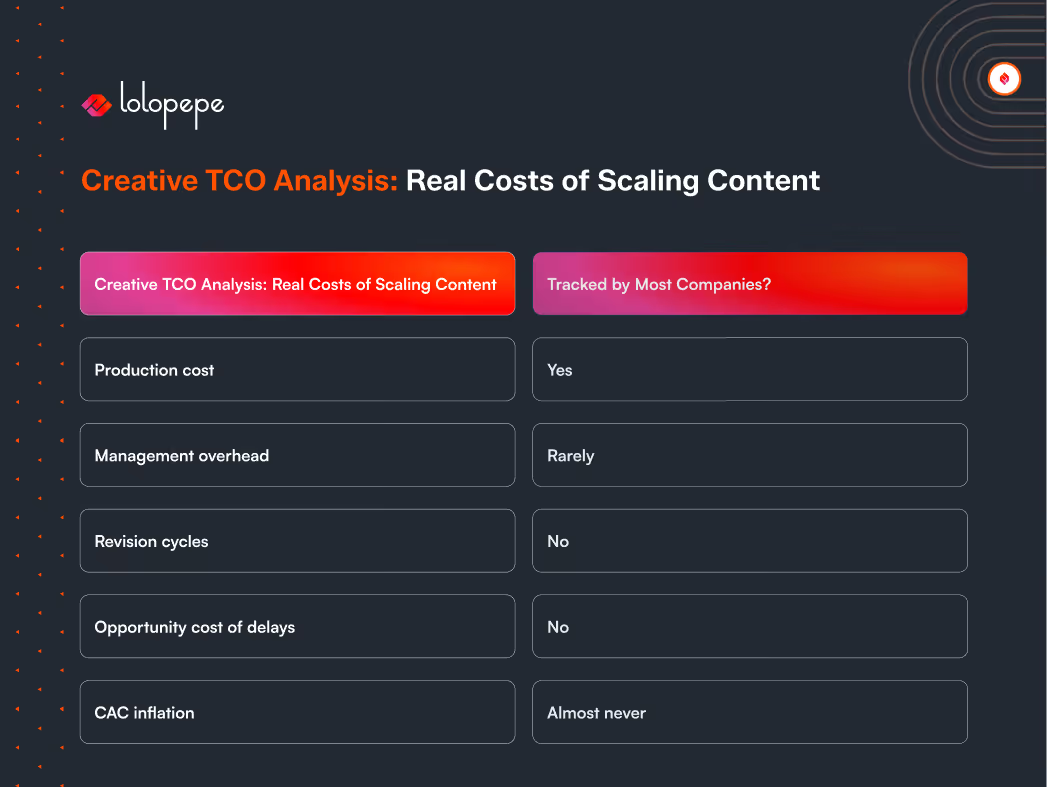
The Five Components of Real Creative Cost
Sticker price is one input. Here areall five:
1. Production cost. The fee paid directly to the creative provider - freelancer rate, agency retainer, or productized subscription. This is the only number most companies track.
2. Management overhead. The internal time spent briefing, reviewing, revising, QA-ing, and re-onboarding creative vendors. Measured in senior marketer or founder hours per week, multiplied by their fully-loaded hourly rate.
3. Revision cycles. The compounding cost of unclear briefs, misaligned expectations, and quality gaps - each revision round consumes both production time and internal review time. Revision cycles are not included in most freelancer or agency quotes.
4. Opportunity cost of delays. Every week a campaign runs without new creative, or with under performing creative that hasn’t been iterated, is a week of inflated CPL. In a $15,000/month ad spend environment, a two-week creative delay costs more than most monthly retainers.
5. CAC inflation from creative underperformance. This is the largest and least-tracked cost. Low-quality or non-iterated creative produces higher CPL, lower lead-to-demorates, and longer sales cycles. The cumulative CAC impact over 6–12 months dwarfs the difference in production fees between models.
The Hidden Management Tax: How Much a Freelancer Actually Costs
The freelancer model shifts creative management entirely onto the buyer.
You write the briefs, run the feedback loops, handle quality control, and re-onboard when they’re unavailable or replaced.
The industry benchmark for freelancer management is 3–5 hours per week of a senior marketer’s or founder’s time.
At a conservative fully-loaded rate of $150/hour:
Management overhead = 4 hours/week × $150/hour × 4.3 weeks = $2,580/month
Add the $800 production fee.
Real TCO: $3,380/month - for a vendor that cost $800 on paper.
And this calculation doesn’t include revision cycles.
In a typical freelance engagement, 30–40% of deliverables require at least one additional round of revision beyond the initial feedback.
Each revision round adds 1–2 hours of internal review time. For 15 assets per month:
5–6 revision rounds × 1.5 hours × $150/hour = $1,125/month in additional overhead
Revised TCO: $4,505/month. For the $800 freelancer.
This is not an unusual scenario. It is the standard operating model for most B2B companies managing freelance creative relationships without a dedicated production system.
Opportunity Cost of Delays: The CAC Spike Nobody Tracks
Creative delays are treated as operational inconveniences. They are actually CAC events.
Consider a B2B SaaS company running $15,000/month in Meta ad spend.
Their current ad creative set was uploaded six weeks ago. CPL has risen from $95 to $140 as the creative fatigues.
They need anew batch - but their freelancer has a two-week turn around.
Those two weeks cost:
$140 CPL× leads generated in 2 weeks - versus $95 CPL with fresh creative.
At 30 leads per two-week period: (30× $140) − (30 × $95) = $1,350 in excess CAC from a single delay event.
Annualized across four creative refresh cycles per year: $5,400 in excess CAC - from delays alone, before touching creative quality.
A productized service with a contractual SLA eliminates this variable entirely. The creative is delivered onschedule.
The refresh cycle is built into the sprint cadence. The $1,350 CAC spike never happens because the two-week gap never exists.
The productized model is not the cheapest sticker price in every case. It is consistently the lowest real TCO - and the only model with a structural mechanism for CAC improvement built into the delivery system.
How Creative Quality Directly Affects CAC
This is the component that compounds. A CPL of $140 versus $88 is not just a line item - it is a multiplier applied to every lead you ever acquire.
If your current creative produces aCPL of $130 and a lead-to-demo rate of 18%, and a systematic creative iteration process moves those numbers to $85 CPL and 26% lead-to-demo rate, the CAC impact is not linear. It is multiplicative.
The difference between Scenario Aand Scenario B is not talent.
It is the presence or absence of a structured hypothesis-test-iterate loop. Freelancers don’t run one. Most agencies run oneat campaign level, not sprint level. Productized services run one weekly, by design.
Every month you operate in Scenario A while Scenario B is available is a quantifiable cost. At 20 demos per month:(20 × $722) − (20 × $327) = $7,900/month in excess CAC. Against a $3,000/month retainer, the break-even is not a question - it is answered in the first sprint.
The Break-Even Analysis: When Does $3,000/Month Pay for Itself?
The question is not “can we afford $3,000/month?” The question is “at what lead volume does $3,000/month cost less than our current setup?”
Using conservative assumptions - aCPL reduction from $120 to $85 (29% improvement) and current ad spend of $10,000/month:
1. Calculate current monthly leads: $10,000 ÷ $120 CPL = 83 leads/month
2. Calculate leads at improved CPL: $10,000 ÷ $85 CPL = 118 leads/month
3. Calculate CPL savings: (83 × $120) − (83 × $85) = $2,905/month in savings on the same lead volume
4. Net cost of the retainer: $3,000 retainer − $2,905 CPL savings =$95/month net cost after CPL improvement
At 83+ leads per month, the retaineris essentially self-funding from CPL reduction alone - before accounting for management overhead savings, elimination of revision cycles, or CAC compounding over 6–12 months.
At lower lead volumes (30–50/month), the math shifts - but the management overhead savings ($2,000–$3,500/month versus current freelance TCO) typically close the gap without requiring CPL improvement to justify the switch.
Frequently Asked Questions
Is the $2,000–$3,500 management overhead estimate realistic for all companies?
It is conservative for most. The 3–5 hours/week figure comes from companies with an established freelance relationship and a defined brief process.
Companies re-onboarding new freelancers after a relationship breaks down - which happens in roughly 40% of freelance engagements within six months - incur an additional 8–12 hours in there-onboarding period.
If you’ve replaced a freelancer once in the past 12 months, your real management overhead is higher than this model assumes.
What if our in-house designer handles creative? Doesn’t that eliminate the TCO argument?
Partially. An in-house designer eliminates management overhead for production tasks, but introduces fixed overhead regardless of output volume, and typically lacks the performance marketing expertise to run a structured creative testing loop.
The CAC inflation component - from non-iterated creative - still applies.
The question is whether your in-house designer is running weekly A/B tests on ad creative, analyzing CPL data by angle and hook, and adjusting briefs sprint-by-sprint. If not, you have the cost structure of an in-house model with the CAC outcomes of a freelance model.
How quickly does CPL typically improve with a systematic creative approach?
Meaningful CPL improvement is typically measurable at 30 days, with a reliable trend established at 60–90 days.
The first sprint rarely produces the largest CPL reduction - it establishes the baseline and identifies the highest-leverage hypotheses.
Sprint 2 and 3, building on validated angles, are where the significant movement usually occurs. This is why the 3-month minimum commitment structure exists: the compounding benefit of iteration is not front-loaded.
Can we run this TCO analysis ourselves before making a decision?
Yes - and you should. The inputs required are: your current production fee, your senior marketer’s hourly rate, your average weekly hours spent on creative management, your revision round frequency, your current CPL, and your monthly ad spend.
Run the five-component model above with your actual numbers. If your real TCO lands above $3,000/month and your creative is not producing a documented CPL improvement trend, the productized model is not a price increase. It’s a cost reduction.
The Bottom Line
The CFO asked the right question.The metric was wrong.
“Why does this cost $3,000?” is a sticker price comparison. The right question is: “What is our current creative setup actually costing us - in management time, revision cycles, delayed campaigns, and inflated CAC - and what would those numbers look like with a system that eliminates each of those variables?”
When that question is answered with actual inputs, the $800 freelancer is rarely the cheapest option. And the $3,000 productized retainer is rarely the most expensive.
The decision is not about creative quality. It is about cost structure and which model produces the lowest real TCO with the strongest CAC trajectory over a 90-day period.
Mirhayot Yunusov
Co-Founder at Eloqwnt | LoloPepe
Mirhayot builds design infrastructure for founders who have no time for fluff. He specializes in turning subjective intuition into scalable Brand Operating Systems that empower Series B+ companies to ship daily.
Through his articles, Mirhayot shares the design thinking, strategic frameworks, and creative decisions behind building brands that look and feel like leaders. Whether it's brand systems, web design, or motion his insights are built from real work with real companies.
Subscribe to our newsletter.
Get valuable strategy, culture, and brand insights straight to your inbox.