

Productized Creative Ops: The Fourth Way to Scale Your B2B Content (And Why the Other Three Are Failing You)
We break down the engineering shift that replaces manual micromanagement with a systematic engine designed for predictable ROI. Learn how to turn creativity into a high-velocity production line that scales without your constant involvement.

Mirhayot Yunusov
Co-Founder at Eloqwnt | LoloPepe

You've probably tried at least two of the three dominant models for scaling B2B creative. Maybe all three.
There was the agency. Six-week onboarding. A discovery session that produced a40-page brand document and three rounds of 'strategic alignment' before a single asset was produced. The retainer was $8,000 a month. The output was slower than what your internal team managed on its own.
Then there was the freelancer. Fast start. The first two deliverables were strong. Then a competing project appeared, response times stretched to three days, and the brief that took you two hours to write came back as something you couldn't use. You started the hiring process again.
Thein-house hire was supposed to fix it. And it did - for about eight months. Then the workload increased, the feedback loops shortened, the quality drifted, and eighteen months in, you were writing a job posting for the same role you'd justfilled.
These aren't coincidences. They're structural failures. Each of the three existing models has a design flaw that makes it unsuitable for the specific creative demands of a scaling B2B company. And until recently, there wasn't a fourth option.
Now there is.
WHAT IS A PRODUCTIZED CREATIVE SERVICE?
A productized creative service is a structured, subscription-based creative operations model that delivers a defined volume of assets per month at a fixed price, on a guaranteed timeline. Unlike agencies (hourly billing, slow delivery) or freelancers (variable reliability), productized services operate like a software product: consistent output, predictable cost, and a built-in iteration loop.
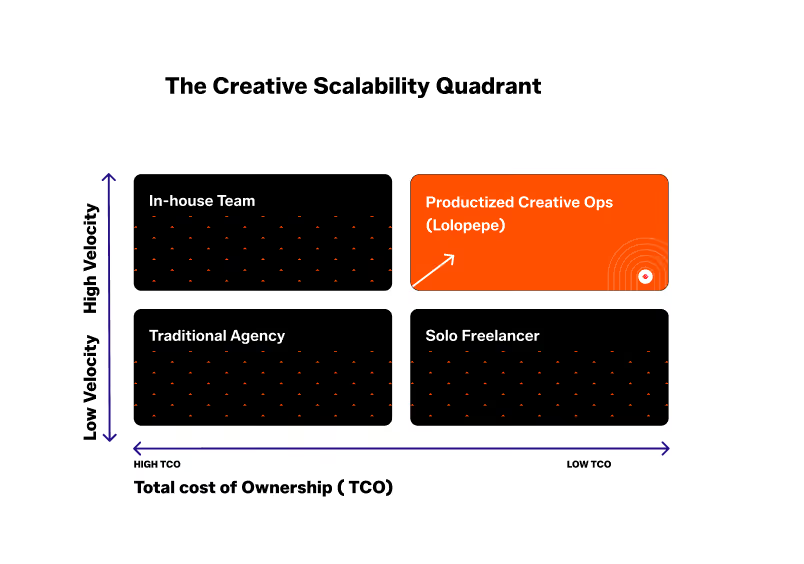
Why the Three Existing Models Are Broken?
Each model fails at the structural level - not because of bad execution, but because of bad design for this specific use case. Understanding the structural flaw in each model is the first step to choosing correctly.
The Agency Model: Built for Campaigns, Not Systems
Agencies are designed for campaigns - discrete, high-budget, time-bounded projects with a clear beginning and end. Brand launches. Annual reports. Market entry campaigns. For these use cases, the agency model is appropriate.
Scaling B2B creative is not a campaign. It's an ongoing operation. You need 15–30 assets per month, every month, at consistent quality, with iteration built into the cycle. Agencies are structurally misaligned with this need.
The specific failure points: hourly billing that inflates with revision rounds, account manager overhead that adds cost without adding output, approval chains calibrated to campaign timelines (weeks, not days), and contracts designed around the agency's capacity management, not your delivery urgency.
The agency model is not broken. It's miscategorized. It solves a different problem than the one scaling B2B companies actually have.
The Freelancer Model: Built for Tasks, Not Infrastructure
Freelancers are the most flexible option and the most structurally fragile. A freelancer is a single person, which means a single point of failure: one illness, one competing project, one change in circumstance, and your production pipeline stops.
More fundamentally, a freelancer is an execution resource, not a system. They produce what you brief them to produce. They don't own the strategy, they don't run the analytics review, they don't build the asset library, and they don't iterate based on performance data. That work still falls on you.
The hidden cost of freelance management: research consistently shows that managing a freelancer costs 3–5 hours per week of a senior marketer's time - briefs, feedback, revisions, QA, and re-onboarding when they're replaced. At a fully-loaded hourly rate, that's $1,500–$3,000/month in invisible overhead on top of the freelancer's fee.
The In-House Model: Built for Stability, Not Scale
An in-house creative team offers control, brand consistency, and immediate availability. It also offers fixed overhead regardless of output volume, management responsibility that grows with the team, and exposure to the most expensive failure mode in creative operations: burnout.
The average in-house creative team in B2B reaches peak burnout at 12–18 months. The combination of volume pressure, unclear success metrics, and the absence of the external perspective that keeps creative fresh produces a predictable degradation curve: output quality drops, turnaround times extend, and the team that was supposed to solve your creative capacity problem becomes a creative capacity problem.
Minimum viable in-house creative team (1 designer + 1 copywriter + 1 strategist): $130,000–$180,000 per year in salaries before benefits, tools, management time, and the 30–60 day onboarding window before anyone is operating at full capacity.
What a Productized Creative Service Actually Is?
The productized model takes the output quality of a specialist team, packages it in a fixed-scope subscription, and delivers it on a sprint cadence with a guaranteed SLA.
Here's what that means in practice:
· Fixed scope: you know exactly what you're getting each month - 15 ad creatives, 15 organic posts, or a defined combination of both. No scope creep, no surprise invoices.
· Fixed price: the monthly fee is the total cost. Production, strategy, iteration, analytics review - all included. You're not paying per revision or per hour.
· Sprint cadence: production runs in weekly cycles. Brief lock on Monday. Batch production Tuesday–Wednesday. Review and delivery Thursday. Data review Friday. The next sprint starts the following week with learnings from the last.
· SLA-guaranteed delivery: the timeline is contractual. Assets delivered by the agreed date. No exceptions negotiated after the fact.
· Built-in iteration loop: performance data from each sprint feeds directly into the next brief. The system gets smarter over time. Your CAC goes down because the creative is improving, not just changing.
The productized model doesn't replace creative thinking with process. It creates the operational infrastructure that allows creative thinking to compound - each sprint building on the data from the last, each asset informed by what worked and what didn't.
The Engineering Creativity Principle
There is a deeper idea behind the productized model, and it's worth naming directly: creative production in B2B has been misclassified as art when it should be classified as engineering.
Art is intuition-dependent, unpredictable, and resistant to process. Engineering is hypothesis-driven, measurable, and improves through iteration. The best creative teams in performance marketing have always worked like engineers - forming hypotheses, running tests, analyzing results, updating the model.
The productized model operationalizes this approach. Every creative sprint is a structured experiment: defined inputs (brief, audience, angle), defined outputs (assets, performance targets), defined review process (data analysis, iteration decisions). The output of a sprint isn't just assets - it's knowledge about what works for this audience, this offer, this channel.
This is what 'Engineering Creativity' means: not removing the creative element, but making the creative process as rigorous, measurable, and iterative as any other growth function in your company.
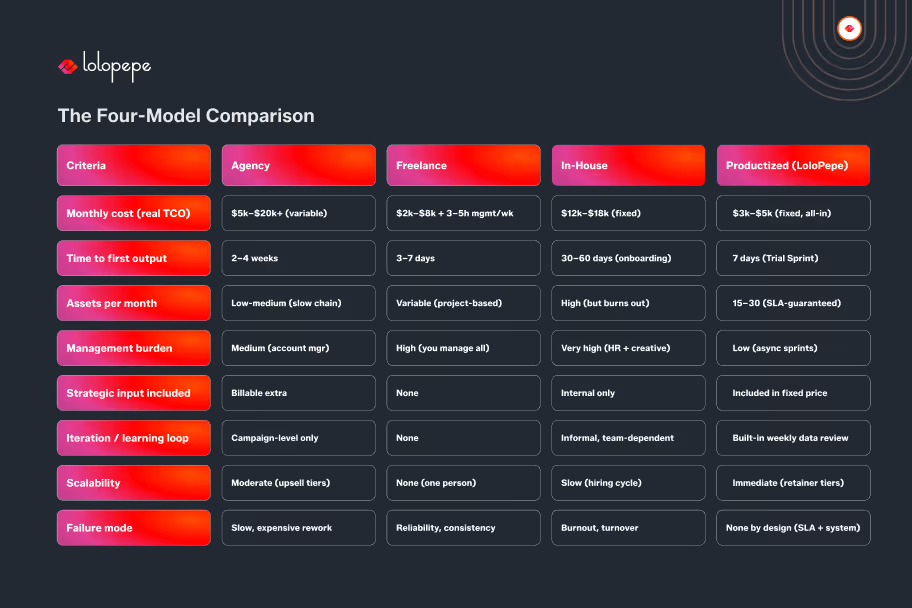
The Four-Model Comparison
Who the Productized Model Is - and Isn't - For
The productized model is not right for every company. Being specific about this is part of what makes it credible.
It's right for you if: you're a B2B SaaS or service company between $1M and $10M ARR. You have product-market fit and are now scaling go-to-market. You need consistent creative output - 15+ assets per month - but don't have the management bandwidth or budget for an in-house team. You've tried agencies or freelancers and found them structurally misaligned with your needs.
It's not right for you if: you're pre-revenue and still finding PMF. At this stage, a freelancer for specific executions is a better use of limited resources. Or if you're at $20M+ ARR with a large marketing org - at that scale, a hybrid model (in-house strategist + productized execution partner) typically outperforms a pure productized setup.
The productized model is designed for a specific growth stage: past early traction, scaling toward market leadership, where creative velocity is a competitive variable and management overhead is a strategic cost to minimize.
Frequently Asked Questions
What exactly is a productized creative service?
A productized creative service is a subscription-based creative operations model that delivers a predefined volume of assets each month at a fixed price on a guaranteed timeline. The 'productized' part means the service is structured like a product - consistent output, defined scope, and predictable delivery - rather than like a traditional agency retainer where scope, timeline, and cost are negotiated per project.
How is a productized service different from a marketing agency retainer?
Three structural differences: (1) Billing model - productized services charge a fixed monthly fee for a defined deliverable scope. Agencies bill hourly or charge retainers with variable scope, meaning cost increases with revision rounds. (2) Delivery speed - productized services run on weekly sprint cycles with SLA-guaranteed delivery. Agency timelines are typically measured in weeks per deliverable. (3) Iteration - productized services include a built-in performance data review each sprint. Agency creative is typically evaluated at the campaign level, not the asset level.
Is the productized model right for early-stage startups?
Generally, no - not until you have product-market fit and a defined ICP. Before PMF, your messaging and positioning are still evolving, which makes systematic creative production premature. A freelancer for specific tactical executions (landing page, pitch deck, one ad campaign) is a better use of limited capital at the pre-PMF stage. The productized model is designed for the scaling phase: post-PMF, $1M+ ARR, where consistent creative velocity becomes a growth lever.
What does 'Engineering Creativity' mean in practice?
Engineering Creativity means treating creative production as a hypothesis-driven, iterative system rather than an intuition-driven art form. In practice: every creative sprint starts with defined hypotheses (this angle, for this audience, should produce this CPL). Assets are produced and launched. Performance data is reviewed at the end of the sprint. The highest-performing angles inform the next sprint's brief. Over time, you build a documented library of what works for your specific audience - which is a compounding asset that makes every subsequent sprint more effective than the last.
The Bottom Line
The three dominant models for scaling B2B creative - agency, freelance, in-house - each fail at the structural level for the same type of company: one that needs consistent, measurable, iterative creative output at a price and speed that reflects the realities of a scaling B2B business.
The productized model was built to fill that gap. It doesn't compete on creativity - it competes on operational reliability, creative velocity, and the compounding advantage of a system that learns.
The shift from 'creative as art' to 'creativity as engineering' is not a loss of creative quality. It's the application of rigor to a function that has historically resisted it and the companies that make that shift are the ones building the most effective content machines in B2B right now.
Download the B2B Creative Model Scorecard - a free one-page self-assessment tool.
Rate your current creative setup across 8 criteria and see which model your company actually needs.
Or start a 7-Day Creative Sprint with LoloPepe for $500 and experience the productized model firsthand.
→ lolopepe.com
Mirhayot Yunusov
Co-Founder at Eloqwnt | LoloPepe
Mirhayot builds design infrastructure for founders who have no time for fluff. He specializes in turning subjective intuition into scalable Brand Operating Systems that empower Series B+ companies to ship daily.
Through his articles, Mirhayot shares the design thinking, strategic frameworks, and creative decisions behind building brands that look and feel like leaders. Whether it's brand systems, web design, or motion his insights are built from real work with real companies.
Subscribe to our newsletter.
Get valuable strategy, culture, and brand insights straight to your inbox.