
Predictable Output, Measurable Learning: The Operating System for B2B Creative Growth
Most B2B creative operations are built on hope. This is the full methodology behind a creative system that delivers on schedule, learns from data, and improves CAC every sprint.

Mirhayot Yunusov
Co-Founder at Eloqwnt | Lolopepe

Two companies. Same LinkedIn feed. Same budget.
One CMO sleeps soundly with a predictable $310/demo pipeline. The other is in a cold sweat at $890/demo, wondering where the money went.
The difference isn't the product or the talent, it’s the operating model. The first company runs a creative growth OS: a closed-loop system where every sprint’s data engineers the next win. The second relies on ad hoc production: briefing when there’s time and reviewing when it’s convenient.
This is a walk-through of that system - from the mechanics of each phase to the outcomes for every ICP.
WHAT IS A CREATIVE GROWTH OPERATING SYSTEM?
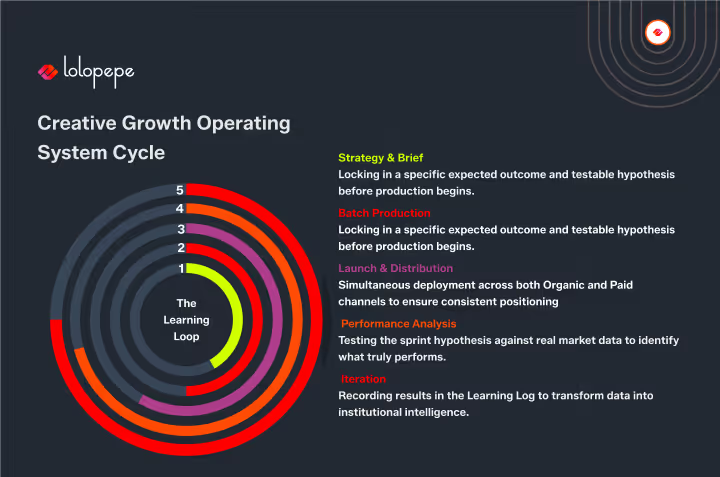
A B2B creative growth operating system is a closed-loop production methodology that moves through five phases each sprint: strategy and brief, batch production, launch and distribution, performance analysis, and iteration.
Each sprint’s data directly informs the next sprint’s brief - creating a compounding learning loop that improves CAC outcomes over time.
What “Operating System” Means in Creative Context
An operating system is the 'DNA of Growth.' It turns creative work from a volatile gamble into a scalable asset, creating the conditions for consistency, quality, and velocity.
For most brands, production is a 'black box.' You put money in, and an ad comes out, but you don't know why. Our Operating System turns that black box into a 'glass engine' where you see every gear, every piston, and exactly how much fuel (data) is needed to reach top speed.
Without it, creative production depends on individual motivation. With it, production becomes an institutional function. A creative service produces deliverables; a creative operating system produces deliverables and compounds learning, ensuring every cycle improves the next.
Phase 1: Strategy and Brief
The brief is the most important document in the system. Every downstream quality problem - assets that don’t perform, revision cycles, misaligned creative - traces back to a brief that was unclear, incomplete, or missing a testable hypothesis.
The operating system brief has six required components:
- ICP Definition: A specific decision-maker with an active pain point right now, not a vague persona.
- Core Angle: A single strategic hypothesis per sprint. Focusing on one message ensures data purity.
- Proof Points: 2–3 validated proofs (statistics or case studies) from your strategic library.
- Channel & Format Specs: Platforms, formats, and character limits. Approved before production begins.
- Hypothesis: A clear formula: "We believe [this angle] will [produce this outcome] for [this ICP segment] based on [data from the last sprint]."
- Success Criteria: Specific KPIs for validation: CPL, Hook Rate, or Lead-to-demo.
This approach turns creative from a "black box" into a transparent growth engine.
Phase 2: Batch Production
All assets for the sprint are produced in a single concentrated session - typically two days. Copy and design work in parallel: copywriter produces all copy variants while designer builds visual templates. Once copy is finalized, it flows directly into design.
The batch production model produces three specific advantages over sequential production:
Brand consistency: Every asset produced in the same session, from the same brief, by the same team. No drift between what was produced on Monday and what was produced on Friday.
Production velocity: Context-switching between assets carries a 20 - 30 minute cognitive overhead per switch. Batch production eliminates this by maintaining one creative context throughout the production session.
Review efficiency: All assets reviewed in a single consolidated session against a pre-approved brief. One 60 - 90 minute review replaces 15 scattered asset-by-asset feedback rounds.
A well-executed batch production sprint for the Performance Creative Engine tier (15 assets per month) takes 2 production days and 1 review day. Total calendar time from brief to delivery: 7 days.
Phase 3: Launch and Distribution
Assets deploy across channels simultaneously - not staggered across weeks. This is the ecosystem principle in action: organic and paid content carrying the same core message launch in the same window, so audiences encounter consistent positioning across touchpoints in the same period.
Launch includes three operational requirements:
- Apply UTM parameters to all paid and organic assets. Attribution must be active from launch, not retroactively.
- Segment audiences according to the brief. Deploy assets strictly against the defined cold and retargeting splits.
- Document baseline metrics. Capture CPL, impressions, and CTR within the first 48 hours to measure sprint performance.
Phase 4: Performance Analysis
Performance data is reviewed at the end of each sprint - not daily, not mid-flight. Reviewing data too early produces noise-driven decisions: an ad that underperforms on Day 3 often recovers by Day 10 as the algorithm optimizes delivery. The operating system enforces a defined review window: 7-14 days for performance creative, 14-21 days for organic content.
The performance review follows a structured format:
- Validate Hypothesis: Analyze which assets confirmed the predicted outcome and which ones refuted it.
- Breakdown Variables: Identify the specific variable (e.g., the hook) that delivered the lowest CPL to inform future tests.
- Monitor Fatigue: Track CPL increases toward the end of the sprint to proactively prioritize creative refreshes.
- Log Learning: Record findings in the Learning Log, transforming sprint data into institutional capital.
Phase 5: Iteration
Iteration is the soul of our OS, turning a simple service into a growth engine. While others just deliver assets, our system uses today’s data to engineer tomorrow’s win.
The iteration brief isn't a "back to the drawing board" moment. It’s a refinement. The winner from your last sprint becomes the champion to beat, while losers are archived in the Learning Log to ensure you never pay for the same mistake twice.
Without iteration, your marketing is just a series of disconnected shouts. With our OS, it becomes a resonant signal. Every sprint creates an "intellectual echo"- the data from last month tells you exactly how to whisper (or shout) this month to make the buyer lean in.
Results Across ICP Types
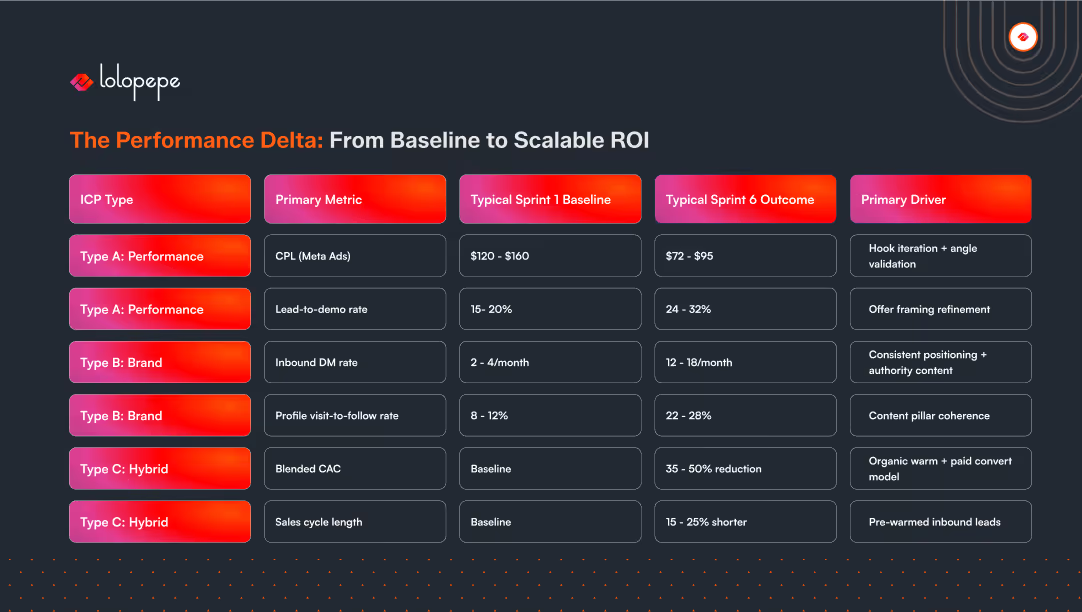
These outcomes are the typical trajectory when the system is run with discipline - briefs locked before production, performance data reviewed on schedule, Learning Log maintained consistently. The system creates the conditions for these outcomes. The data and iteration decisions determine whether they are achieved.
Frequently Asked Questions
Q: How involved does our team need to be in the operating system?
A: The system minimizes your burden to just 2.5 - 3 hours per sprint. Your focus is required only for three key "glass engine" moments: brief sign-off, consolidated asset review, and performance-based iteration approval.
The OS is designed to remove the 'Founder’s Shadow' from production. You stop being the bottleneck for every font or headline; instead, the system acts as your surrogate, enforcing your standards while the machine handles the iterations.
Q: What happens if we want to change direction mid-sprint?
A: Mid-sprint shifts are capacity killers, so we enforce a brief-lock to keep production clean. If your strategy pivots, we pause for 1–2 days to realign the brief rather than wasting effort on 15 assets that no longer fit. It’s about choosing the "glass engine" precision over the "black box" chaos.
Q: How is the Learning Log structured and who owns it?
A: Maintained by our strategist, the Learning Log documents every hypothesis, metric, and outcome to ensure the system compounds. It turns "Goldfish Memory" into institutional intelligence. Most importantly, it is client-owned; if we ever part ways, the map of what works for your audience stays with you.
Q: How long before we see meaningful results from the operating system?
A: Sprint 1 sets your baseline, and by Sprint 3, you’ll typically see the first real performance lift as we build on validated wins. The compounding effect is real: after 6+ sprints, companies often see a 35–55% CPL improvement from their starting point. It’s not a miracle; it’s just engineering.
The Bottom Line
Most B2B creative operations are not systems. They are collections of individual projects managed by individuals, producing inconsistent output, generating data that is rarely reviewed, and repeating the same mistakes quarter after quarter because there is no mechanism for institutional learning.
The operating system changes this at the structural level. It does not require better creative talent. It requires a methodology that captures what works, documents what doesn’t, and uses that knowledge to produce better creative in the next cycle.
The distance between a $310 cost-per-demo and an $890 cost-per-demo is not talent. It is process. And process can be built.
See the operating system in action before committing to a retainer.
Discover the Operating System without the long-term commitment.
Start a 7-Day Creative Sprint for $750. From Brief to Delivery in one week.
Or book a Discovery Call to walk through the operating system applied to your specific ICP and channel mix.
Mirhayot Yunusov
Co-Founder at Eloqwnt | Lolopepe
Mirhayot builds design infrastructure for founders who have no time for fluff. He specializes in turning subjective intuition into scalable Brand Operating Systems that empower Series B+ companies to ship daily.
Through his articles, Mirhayot shares the design thinking, strategic frameworks, and creative decisions behind building brands that look and feel like leaders. Whether it's brand systems, web design, or motion his insights are built from real work with real companies.
Subscribe to our newsletter.
Get valuable strategy, culture, and brand insights straight to your inbox.