
Full-Stack Creative Ecosystems: How to Align Organic and Paid for 40% Lower CAC
Stop paying the "stranger tax" by running siloed channels that ignore each other. We break down the ecosystem math where organic warms the crowd, and paid simply closes the deal. Learn how a single shift in creative architecture cuts your CAC by 40% - no budget increase required

Mirhayot Yunusov
Co-Founder at Eloqwnt | LoloPepe

Running organic and paid separately is like asking a drummer and a violinist to perform in different rooms and hoping the audience hears a symphony. Individually, they might be talented, but without a shared conductor (your master brief) and a shared score (your asset library), all the audience hears is noise.
A full-stack ecosystem is that conductor.
WHAT IS A FULL-STACK CREATIVE ECOSYSTEM?
A full-stack creative ecosystem is a unified strategy where organic content (LinkedIn, blog, social) and paid advertising (Meta, LinkedIn Ads) share a single messaging framework, asset library, and production sprint - so organic warms the audience and paid converts it.
This coordination reduces CAC by 30-40% compared to running siloed channel strategies.
Why Channel Silos Inflate CAC
When organic and paid operate independently, three compounding problems emerge.
1. Audience fragmentation. Your paid ads are introducing your brand to an audience that has never encountered your organic content. You’re paying to introduce, not to convert. Every impression starts from zero.
In a well-structured ecosystem, paid ads reach audiences already familiar with your positioning from organic, which means you’re paying to convert, not to introduce. That’s the mechanism behind the 30-40% CAC reduction.
2. Messaging inconsistency. Your organic team writes about thought leadership. Your paid team writes about features. Your email team writes about product updates.
A prospect encountering all three in the same week gets a fragmented brand impression - and fragmented impressions don’t build trust.
Trust in B2B is built by predictable familiarity. When a prospect sees a thought-provoking post on LinkedIn and then encounters an ad with the same visual logic ten minutes later, it creates resonance.
Inconsistency, on the other hand, triggers a subconscious 'red flag' - if they can't coordinate their ads, can they coordinate their software?
Trust requires repetition of the same message across multiple touchpoints.
3. Production waste. Your team spends 20% of their week just 'translating' ideas from one channel to another. This is digital friction.
It’s the hidden tax you pay for not having a unified system. A single unified sprint producing 30 assets is a high-velocity engine; three separate workflows are just three ways to stall your growth.
The Organic-Warms-Paid-Converts Model
Organic, paid, and email are not three separate campaigns. There are three stages of one funnel with a specific sequencing logic:
- Organic content (LinkedIn posts, blog, social) builds audience familiarity and positions your brand as a credible authority. It warms cold audiences into warm ones. It does not need to convert - that is not its job.
- Paid advertising (Meta, LinkedIn Ads) converts the warm audience that organic has built. When retargeting audiences who have engaged with organic content, CPL is typically 30-45% lower than cold acquisition - because the brand introduction has already happened.
- Email retains, educates, and upsells the customers that paid has converted. It deepens the relationship and increases LTV.
The sequencing matters. Organic before paid. Paid before email. Each stage makes the next stage more efficient. When you run them in parallel without coordination, you lose the compounding efficiency of the sequence.

The Unified Asset Library: One Sprint, Two Channels
The operational expression of the ecosystem model is a unified asset library built in a single production sprint. The principle: one core creative direction - one positioning angle, one ICP, one proof point - produces assets for every channel simultaneously.
A single batch production day yields:
- LinkedIn carousel - organic, educational format
- LinkedIn text post - organic, conversation-starting format
- Meta ad static - paid, conversion-focused
- Meta ad video script - paid, hook-driven
- Email header and subject line variants - nurture/retention
- Landing page headline variant - conversion layer
All from one brief. All carrying the same core message. All reinforcing each other when a prospect encounters them across channels in the same week.
The asset library compounds over time. Every sprint adds to a searchable, tagged repository of creative that can be adapted, refreshed, and redeployed. Sprint 12 is faster and cheaper than Sprint 1 - because you’re building on an established foundation, not starting from zero.
How to Build the Ecosystem: Step by Step
- Audit your current channels. Map every active asset: LinkedIn posts, ad creatives, email templates, landing page copy. Identify messaging overlaps and gaps. The goal is to diagnose fragmentation, not catalog content.
- Define one unified messaging hierarchy. Lock three things before any creative is produced: your primary ICP for the current quarter, your core offer angle (the single reason they should care right now), and your content pillar hierarchy (3 - 5 topics that support the core angle). Every asset traces back to this hierarchy.
- Build the master brief. One brief per sprint cycle - not one per asset. The master brief defines ICP, angle, proof points, visual direction, tone, and channel-specific format requirements. This is the document that makes unified production possible.
- Synchronize production sprints. All channels briefed and produced in the same sprint cycle. Organic content produced the same week as ad creative. Email produced alongside social. Synchronized production prevents messaging drift.
- Build the cross-channel feedback loop. Data from each channel informs the others. Lowest-CPL angles from paid move into organic. Highest-open-rate subject lines from email inform ad hooks. The ecosystem learns from itself.
Attribution in a Full-Stack Ecosystem
Unified ecosystems require a multi-touch attribution model. Last-touch attribution - crediting only the final conversion event - systematically undervalues organic and email because they rarely appear as the last touchpoint.
Three attribution approaches for ecosystem marketing:
- Time-decay multi-touch: Distributes credit across all touchpoints, weighted toward recency. Best for B2B with longer sales cycles. Captures the contribution of organic content that warmed the audience weeks before conversion.
- First-touch + last-touch split: Attributes 40% of credit to the first touchpoint (usually organic) and 40% to the last (usually paid or sales). Acknowledges both the awareness and conversion layers. Simpler to implement than full multi-touch.
Revenue-weighted channel analysis: Track close rate and deal size by lead source and channel combination. Leads who engaged with both organic and paid before converting typically close at higher rates and larger deal sizes - quantifying the ecosystem premium.
The CAC Math: What 40% Reduction Actually Looks Like
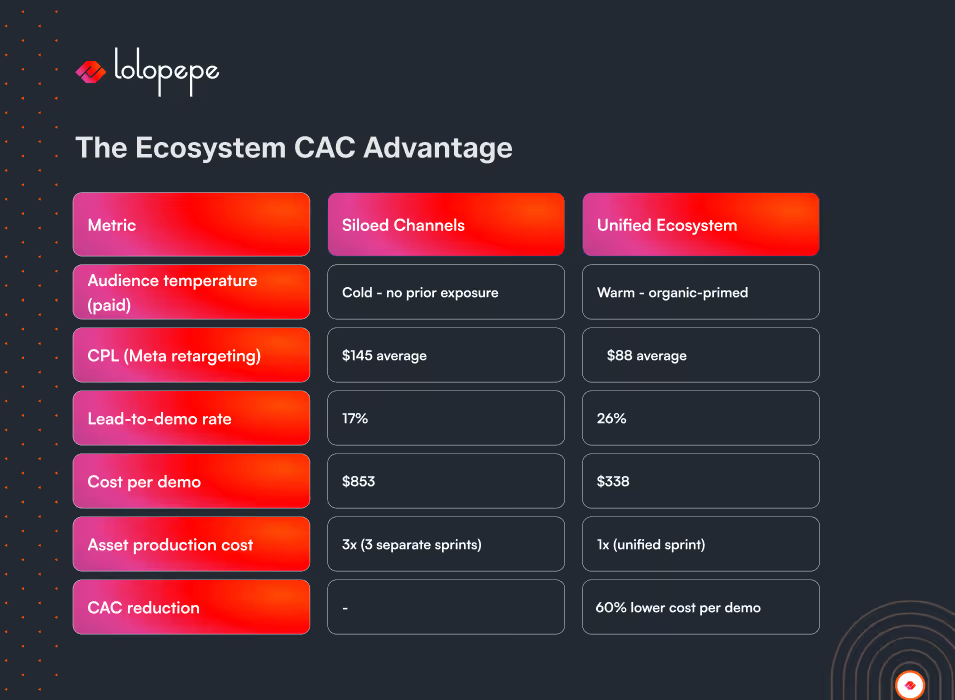
The mechanism behind CAC reduction in a unified ecosystem is retargeting efficiency. Here’s the math:
The $145 vs $88 CPL difference is not a creative quality difference. It is a warm vs cold audience difference. Organic content created the warm audience. Paid advertising captured it. The ecosystem made the math work.
Frequently Asked Questions
Q: Do organic and paid need to run simultaneously for the ecosystem to work?
A: Ideally yes, but the minimum requirement is sequencing. If your organic cadence is weekly and your paid refreshes monthly, the retargeting audience you’re building organically will be ready when paid refreshes. What destroys the ecosystem is messaging divergence - organic and paid carry completely different angles, so even a warm audience encounters contradictory signals.
Q: What if our paid team and organic team are different vendors or internal owners?
A: This is the most common source of ecosystem failure. The fix is a single master brief and a synchronized sprint cycle - regardless of who executes. One strategy document, reviewed by both owners before production begins, prevents messaging drift at the source. The Full-Stack Creative Ops model solves this structurally by placing both channels under one creative strategy layer.
Q: How long before the CAC reduction is measurable?
A: The retargeting efficiency gain is typically measurable at 45 - 60 days, when the paid audience has had sufficient exposure to organic content and the retargeting pool is large enough to show statistical significance. The full compounding effect, where the asset library and learning loop are both maturing, is typically visible at 90 days.
Q: Can this model work for companies under $1M ARR with limited budgets?
A: At sub-$1M ARR, the ecosystem model is valid but should be simplified. One organic channel (LinkedIn), one paid channel (Meta retargeting only), no email automation yet.
The core principle - organic warms, paid converts - applies at any budget. The sprint structure and asset library still apply. The scale is smaller, not the approach.
The Bottom Line
Channel siloing is not a resource problem. Most companies running separate organic and paid programs have the budget to build a unified ecosystem - they just haven’t restructured the production model to enable it.
The 40% CAC reduction is not a promise of better creativity. It is the mathematical outcome of a warm audience encountering a consistent message at the conversion moment - instead of a cold audience seeing a brand for the first time in a paid ad.
Moving to a full-stack ecosystem isn't just a marketing tweak. It's an operational lever. You’re not working harder; you’re making the work you already do travel further. One brief, one sprint, one ecosystem - 40% lower CAC. That’s not a miracle. It’s engineering.
The shift from siloed channels to a full-stack ecosystem is an operational decision, not a creative one. It requires one shared brief, one synchronized sprint, one asset library, and one attribution model. The creative talent you already have can execute it. The question is whether your production structure allows it.
LoloPepe’s Full-Stack Creative Ops unifies your organic, paid, and email creative into a single sprint-based system - one partner, one strategy, one source of truth.
→ Stop managing silos. Start a 7-Day Creative Sprint for $750 and see how a unified ecosystem crushes your CAC. Or, start with a Creative Ecosystem Audit to find your biggest leaks at lolopepe.com
Mirhayot Yunusov
Co-Founder at Eloqwnt | LoloPepe
Mirhayot builds design infrastructure for founders who have no time for fluff. He specializes in turning subjective intuition into scalable Brand Operating Systems that empower Series B+ companies to ship daily.
Through his articles, Mirhayot shares the design thinking, strategic frameworks, and creative decisions behind building brands that look and feel like leaders. Whether it's brand systems, web design, or motion his insights are built from real work with real companies.
Subscribe to our newsletter.
Get valuable strategy, culture, and brand insights straight to your inbox.