

Engineering Creativity: Why the Best B2B Creative Teams Think Like Product Teams
We break down the framework that turns the "black box" of creativity into a predictable engine of sprints, hypotheses, and compounding ROI. Discover why the best brands no longer wait for inspiration; they engineer it.

Mirhayot Yunusov
Co-Founder at Eloqwnt | LoloPepe

Think about your creative team’s last launch. Was it a predictable execution of a strategy, or did it feel like a high-stakes bet where everyone was crossing their fingers?
In most B2B companies, product teams live in a world of data and sprints, while creative teams live in a world of 'vibes' and last-minute Slack messages.
Hope is not a creative strategy.
ENGINEERING CREATIVITY DEFINED
Engineering Creativity is the practice of applying product development principles - sprint cadences, hypothesis testing, data-driven iteration - to creative production.
Instead of treating creative output as art (intuition-dependent, unpredictable), Engineering Creativity treats it as an engineering discipline: structured, measurable, and designed to improve with every cycle.
Why Creative Has Been Misclassified as Art
We’ve been sold a myth: that creative work only happens when 'The Muse' strikes or inspiration hits. But in B2B performance marketing, waiting for inspiration is a luxury your CAC cannot afford. Engineering Creativity doesn't kill the muse, it gives her a deadline, a desk, and a dashboard.
The evidence is in the outcomes. B2B creative teams operating on intuition produce inconsistent results: some campaigns perform, most don’t, and the team can rarely explain why with precision.
B2B creative teams operating on structured iteration produce compounding results: each sprint builds on validated learning from the last, and performance improves predictably over time.
The companies that have made this shift - treating creative production as a hypothesis-driven, data-measured discipline - are building the most efficient content machines in B2B right now. The ones still treating it as art are funding expensive intuition.
What Product Teams Know That Creative Teams Don’t
Trying to scale B2B marketing with a traditional creative process is like driving a Ferrari with the handbrake on. You have the engine (budget) and the driver (talent), but the internal friction of 'guessing' what works keeps you from ever reaching top speed.
Product development adopted engineering principles because the cost of shipping without validation was too high. A feature built on assumption and shipped without testing could waste months of engineering time. The solution was a structured process: define a hypothesis, build the minimum viable version, ship, measure, iterate.
Creative production in B2B has the same economics. An ad campaign built on assumption and launched without a testing framework wastes budget on underperforming creative. The solution is identical: define a hypothesis, produce the minimum viable creative set, launch, measure, iterate.
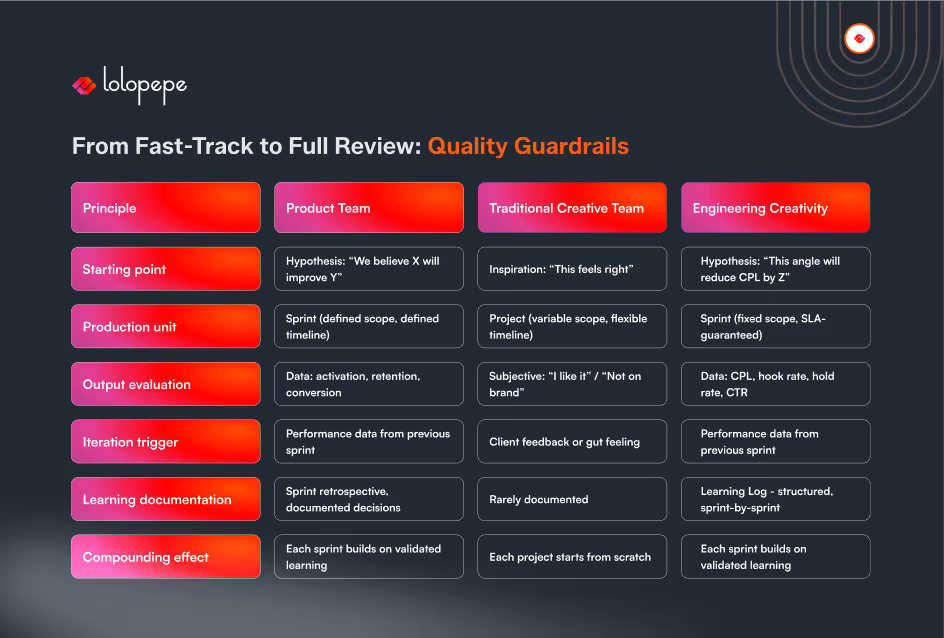
The Engineering Creativity Framework: Core Principles
1. Hypothesis before production. Every creative sprint starts with a documented hypothesis. Not “we’re making 15 ads this month” but “we believe a hook focused on CPL reduction will outperform our current feature-benefit hook for Type A ICP, based on last sprint’s data showing 22% lower scroll-stop rate on feature-led creatives.” The hypothesis defines what you’re testing and what success looks like before a single asset is produced.
2. Fixed-scope production sprints. Creative is produced in defined batches on defined timelines - not on-demand, not as individual project requests. This is the sprint cadence. It forces prioritization, enables batch production efficiency, and creates the regular data-collection cycle that powers iteration.
3. Structured performance review. At the end of every sprint, performance data is reviewed against the hypothesis. Which assets performed? Which underperformed? What does the data suggest about the next hypothesis? This is not an optional retrospective. It is the mechanism that closes the learning loop and prevents the next sprint from repeating the previous sprint’s mistakes.
4. Learning Log as institutional memory. Every sprint produces a documented record: hypotheses tested, assets produced, performance outcomes, iteration decisions. Without a Learning Log, your creative team has 'Goldfish Memory.' You test an angle in Q1, forget the result by Q3, and repeat the same mistake in Q4. A Learning Log turns your team from a group of artists-for-hire into an Intelligence Unit that actually knows your customer’s triggers.
5. Asset ownership, not deliverable consumption. Engineering Creativity treats creative assets as capital - owned, catalogued, reusable. Not as deliverables consumed and discarded. The asset library that accumulates over 12 months of structured sprints is worth more than any individual campaign.
Sprint Thinking Applied to Creative
A creative sprint in the Engineering Creativity model follows a five-stage cycle:
- Brief and hypothesis (Day 1). Lock the ICP, the core angle, the proof points, the channel requirements, and the specific hypothesis being tested. One master brief. One creative direction. No ambiguity.
- Batch production (Days 2 - 3). All assets for the sprint produced in a single concentrated session. Copy and design in parallel. Same brief, same creative direction, same context throughout. This is where the efficiency of the sprint model is realized.
- Launch and distribution (Day 4). Assets deployed across channels simultaneously. Paid ads into Ads Manager. Organic posts scheduled. Email queued. All carrying the same core message.
- Performance data collection (Days 5 - 14). Assets run against a consistent audience for a defined period. Data collected: CPL, hook rate, hold rate, CTR, lead-to-demo rate. No optimization mid-flight - let the hypothesis run to completion.
- Review and iteration brief (Day 14). Data reviewed against the hypothesis. Winner identified, loser documented, new hypothesis generated. The next sprint’s brief is written on the basis of this review - not on intuition.
This cycle repeats every two weeks. Each cycle produces not just assets, but validated learning that makes the next cycle more effective.
The Learning Loop: How Systems Get Smarter Over Time
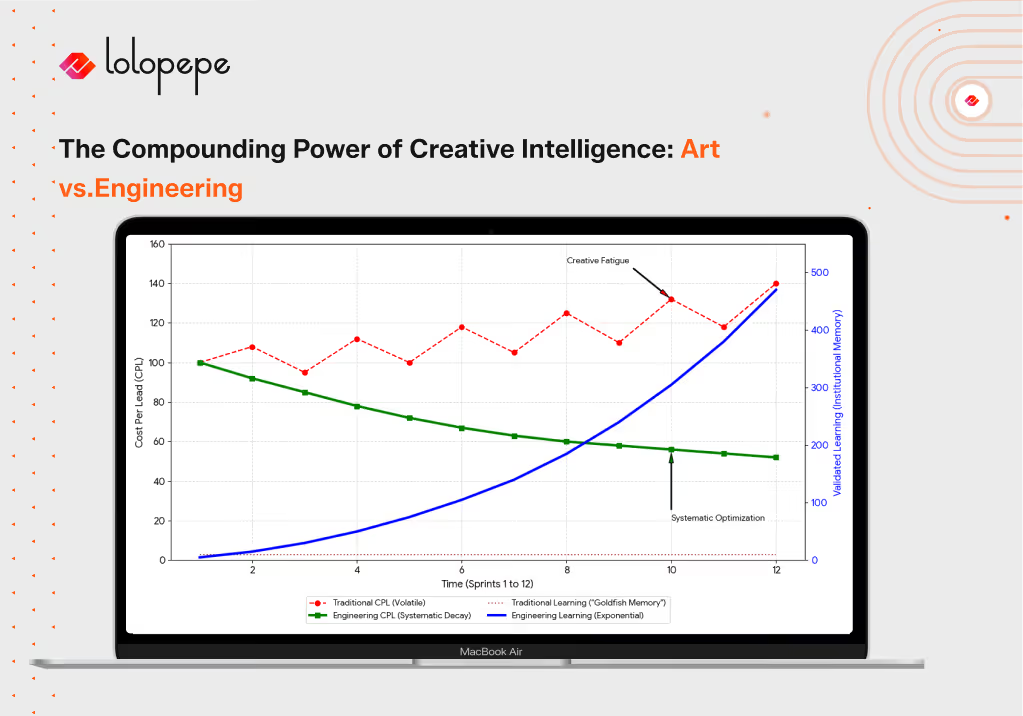
The compounding advantage of Engineering Creativity is in the learning loop. Each sprint’s data informs the next sprint’s hypothesis. Over time, this produces a documented map of what works - which angles resonate with which ICP segments, which hooks drive the highest scroll-stop rate, which proof points move the lead-to-demo needle.
A team running Engineering Creativity for six months has six months of validated creative intelligence. A team running traditional creative for six months has six months of assets and a general sense that some things worked.
The performance trajectory reflects this. Traditional creative teams typically see flat or declining CPL over time as creative fatigues and the team lacks the structured data to understand why. Engineering Creativity teams see declining CPL over time because each sprint is systematically replacing what didn’t work with a better-validated alternative.
What Engineering Creativity Is Not
Anticipating the objection: does engineering creative production remove the creative element? Does systematic iteration produce formulaic, generic content?
Engineering your creative doesn't make it boring, it makes it surgical. It's the difference between throwing paint at a canvas and hoping it looks like a person, and an architect drawing a blueprint. Both require vision, but only one is built to last.
No - and the confusion is in the framing. Engineering Creativity doesn’t eliminate creative judgment. It structures when and how creative judgment is applied.
The hypothesis stage requires deep understanding of the ICP, the market, and the positioning - that is creative and strategic thinking. The production stage requires genuine craft in execution - that is creative work. What Engineering Creativity eliminates is the application of creative judgment to the wrong questions: “does this feel right?” and “do I like it?” are not the right evaluation criteria. “does this perform?” is.
The most creative teams in B2B - the ones producing the most distinctive, memorable, effective content - are typically the ones with the most structured iteration process. The structure doesn’t constrain creativity. It directs it toward what matters.
Frequently Asked Questions
Q: How is Engineering Creativity different from just “A/B testing your ads”?
A: A/B testing is one tool inside the Engineering Creativity framework - not the framework itself. Most A/B testing in B2B is ad hoc: test two versions, pick the winner, move on. Engineering Creativity is a structured system: hypothesis before production, defined testing cadence, documented Learning Log, sprint-level iteration brief. The difference is between a single experiment and a scientific method applied consistently over time.
Q: Does Engineering Creativity work for brand content, not just performance creative?
A: Yes - with adapted metrics. For brand content (LinkedIn, thought leadership, organic), the performance data is engagement rate, inbound DM rate, follower growth, and share volume - not CPL. The hypothesis-test-iterate structure applies identically. “We believe a post framing our positioning as a category-creation story will drive higher share volume than a tactical how-to post” is a testable brand content hypothesis. The sprint cycle and Learning Log function the same way.
Q: How long before Engineering Creativity produces measurable improvement?
A: The first sprint establishes the baseline and tests the first hypothesis. Meaningful performance improvement is typically visible at Sprint 3 or 4 - when the learning loop has cycled twice and validated angles are being built upon. The compounding effect accelerates from there. Teams that have run the model for 6+ months typically see CPL reductions of 30 - 60% from their Sprint 1 baseline.
Q: Can a small team (one designer, one copywriter) run this model?
A: Yes. The Engineering Creativity framework is not dependent on team size - it’s dependent on process discipline. A two-person team running structured sprints with a documented Learning Log will outperform a five-person team running ad hoc creative production. The constraint is not headcount. It is the willingness to treat creative production as a disciplined, measurable function rather than an inspired one.
The Bottom Line
The companies building the most effective B2B content machines in 2026 are not the ones with the most talented creatives. They are the ones that have structured the creative function to operate like a product team: hypothesis-driven, sprint-cadenced, data-measured, and systematically iterative.
Engineering Creativity is not a constraint on creative quality. It is a forcing function for creative accountability - the discipline that turns creative intuition into compounding creative intelligence.
The shift from art to engineering doesn’t require different people. It requires a different operating model.
Ready to stop guessing? Download the Engineering Creativity Framework - or see the system in action by booking a 7-Day Creative Sprint for $750. Experience the difference between art and engineering.
Or subscribe to The B2B Creative Ops Newsletter - weekly insights on creative systems, iteration methodology, and performance data from the field.
Mirhayot Yunusov
Co-Founder at Eloqwnt | LoloPepe
Mirhayot builds design infrastructure for founders who have no time for fluff. He specializes in turning subjective intuition into scalable Brand Operating Systems that empower Series B+ companies to ship daily.
Through his articles, Mirhayot shares the design thinking, strategic frameworks, and creative decisions behind building brands that look and feel like leaders. Whether it's brand systems, web design, or motion his insights are built from real work with real companies.
Subscribe to our newsletter.
Get valuable strategy, culture, and brand insights straight to your inbox.