

Creative Testing Velocity: How Fast Iteration Beats Big Budgets in B2B Advertising
Budget buys reach, but velocity buys the intelligence that actually lowers lead costs. We dismantle the myth of the "big spender" advantage, proving how disciplined weekly sprint cycles compound learning into a durable competitive moat.

Mirhayot Yunusov
Co-Founder at Eloqwnt | LoloPepe

The growth lead at a Series A B2B SaaS company had a problem she couldn’t explain to her board. Her competitor - a Series B company with five times her ad budget - was not generating five times her pipeline. In some months, she was generating more.
Same platform. Same ICP. Same general offer category. Different ad spend. Different outcomes.
She found the answer in a performance review conversation with her counterpart at the Series B company (a rare moment of competitive transparency). The Series B team was running three to four new creative tests per month. She was running sixteen.
Budget buys reach. Velocity buys learning. And in B2B paid advertising, learning compounds in a way that reach does not.
This is the mechanics of how that compounding works - and the operational framework for building a velocity advantage regardless of budget.
CREATIVE TESTING VELOCITY DEFINED
Creative testing velocity is the rate at which a B2B advertising team accumulates validated creative learning. High-velocity teams (15 - 20 tests per month) compound learning faster than high-budget teams (2 - 4 tests per month) - because each test produces data that improves the next brief. After 6 months, a high-velocity team with a $10,000/month budget typically achieves lower CPL than a low-velocity team with a $40,000/month budget.
Why Budget Is the Wrong Competitive Variable
On Meta, the algorithm is like a hyper-intelligent, hungry engine. You don't build a fence around your audience with technical settings. You throw the right 'bait' (creative) into the water and let the machine find where the biggest fish are hiding. It does not compound. A $40,000/month advertiser who has been running for 12 months with low testing velocity has 12 months of reach. They do not have 12 months of compounding creative intelligence.
Creative intelligence - the validated knowledge of which angles, hooks, formats, and offers produce the lowest CPL for your specific ICP - is a compounding asset. Each test adds to the base. Each validated winner becomes the control against which the next hypothesis is tested. Over 12 months of high-velocity testing, the learning gap between a systematic tester and an ad-hoc tester is enormous - and it is reflected directly in CPL.
The implication: a well-resourced competitor with low testing velocity is not as strong a competitor as they appear. Their budget is buying reach. It is not buying learning. A lean team with high testing velocity is accumulating creative intelligence faster than they are - and the CPL curves will cross within 3 - 6 months.
Budget is a machine gun: it sprays lead (impressions) across the battlefield, hoping to hit something. Creative velocity is a sniper's learning process. Each shot isn't just an attempt to hit a target; it's a calibration of wind, distance, and angle. A sniper who fires 20 rounds of data-backed shots will always outperform a machine gunner who just bought more ammo but hasn't adjusted their aim in months.
What Creative Testing Velocity Actually Is
Testing velocity is not the same as running a lot of ads. It is the rate at which a team moves through the complete cycle: hypothesis → production → launch → data → learning → new hypothesis.
A team running 20 ad variants simultaneously but never reviewing performance data has high creative volume and zero testing velocity. The variants produce data that no one is acting on. The learning loop is open.
Testing velocity requires four operational components:
1. Hypothesis-driven production. Every creative variant is testing a specific claim: “we believe a hook focused on the hidden cost of freelancers will produce lower CPL than our current product-benefit hook for the CMO segment.” Without a documented hypothesis, you cannot measure whether the test validated or refuted anything.
2. Defined test window. Meta audiences are ruthless. They'll love your ad on Monday and ghost it by next Thursday. If you aren't shipping 3 - 5 new variants every sprint, you aren't running a campaign - you're just waiting for the decay to set in.
3. Structured performance review. At the end of each test window, performance data is reviewed against the hypothesis. Winner identified. Loser documented. New hypothesis generated. This review takes 30 - 45 minutes when it is structured. Teams without a structured review spend 3 - 4 hours on the same exercise, or skip it entirely.
4. Learning Log. Every hypothesis outcome is documented. The Learning Log is the compounding asset of the velocity framework: 12 months of documented test outcomes, organized by variable tested and performance result, is a map of the creative landscape for your specific ICP. It is worth more than any individual campaign.
The Compounding Math: How Velocity Builds a CPL Moat
Think of creative learning like compound interest. A low-velocity team takes their 'interest' (data) and spends it immediately. A high-velocity team reinvests every single insight back into the principal (the next brief). By month six, the gap isn't just linear, it's exponential. You aren't just outspending them- wealth of knowledge has made their budget irrelevant.
The CPL trajectory divergence between high-velocity and low-velocity teams is predictable and quantifiable.
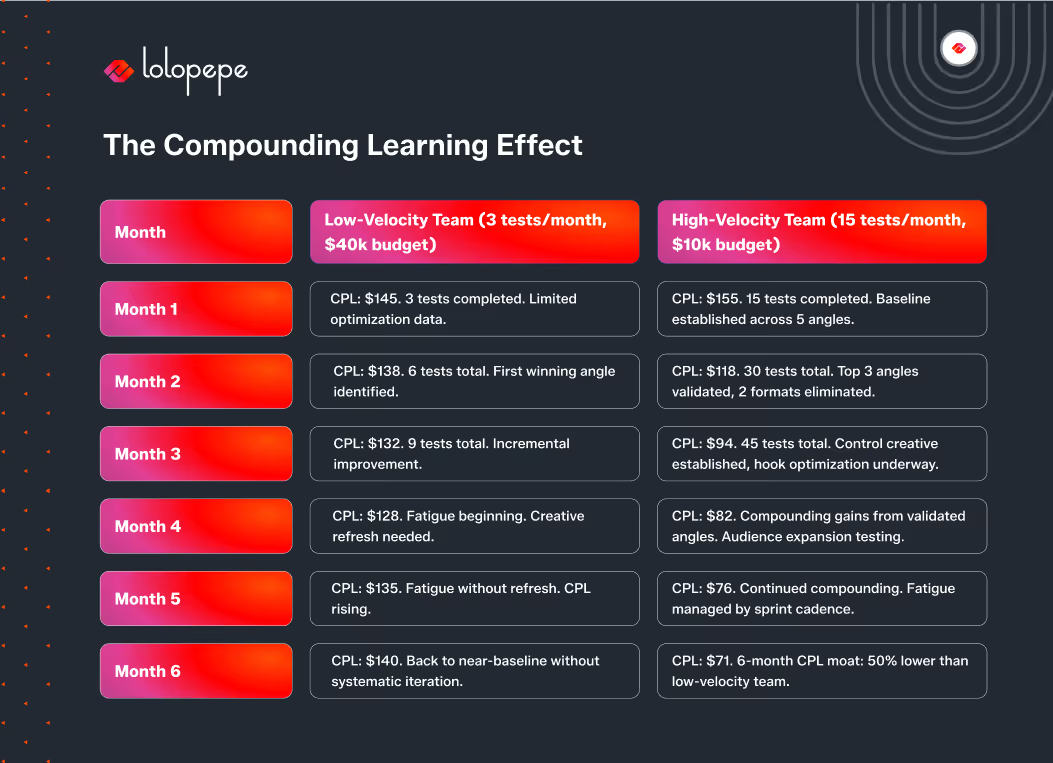
The high-velocity team’s CPL advantage at Month 6 is not primarily a function of their lower budget - it is a function of 90 additional validated learning cycles. They know more about what works for their ICP than the low-velocity team does, and that knowledge is encoded in their creative production system.
Time-to-Learning (TTL): The Metric That Drives Velocity
Time-to-learning (TTL) is the elapsed time from “brief approved” to “performance data available and reviewed.” It is the single most important operational metric for creative testing velocity.
Most B2B advertising teams have a TTL of 3 - 4 weeks:
- Brief writing: 2 - 3 days (async, reactive)
- Creative production: 5 - 7 business days
- Review and revision: 3 - 5 days
- Launch: 1 - 2 days
- Test window: 14 days
- Performance review: scheduled for “next week” - happens in 10 days
Total TTL: 25–32 days. At this TTL, a team completes 11 - 15 learning cycles per year.
High-velocity teams achieve a TTL of 7–10 days:
- Brief: locked Monday in 60 - minute session (same day as previous sprint review)
- Production: batch session Tuesday - Wednesday (2 days)
- Review and revision: Thursday (same day delivery)
- Launch: Friday
- Test window: 7 days
- Performance review: following Monday (next sprint brief session)
Total TTL: 14 days including test window. At this TTL, a team completes 26 learning cycles per year - 2.3x more than the slow-TTL team on the same calendar.
The Velocity Gap: Where Most B2B Teams Are vs Top Performers
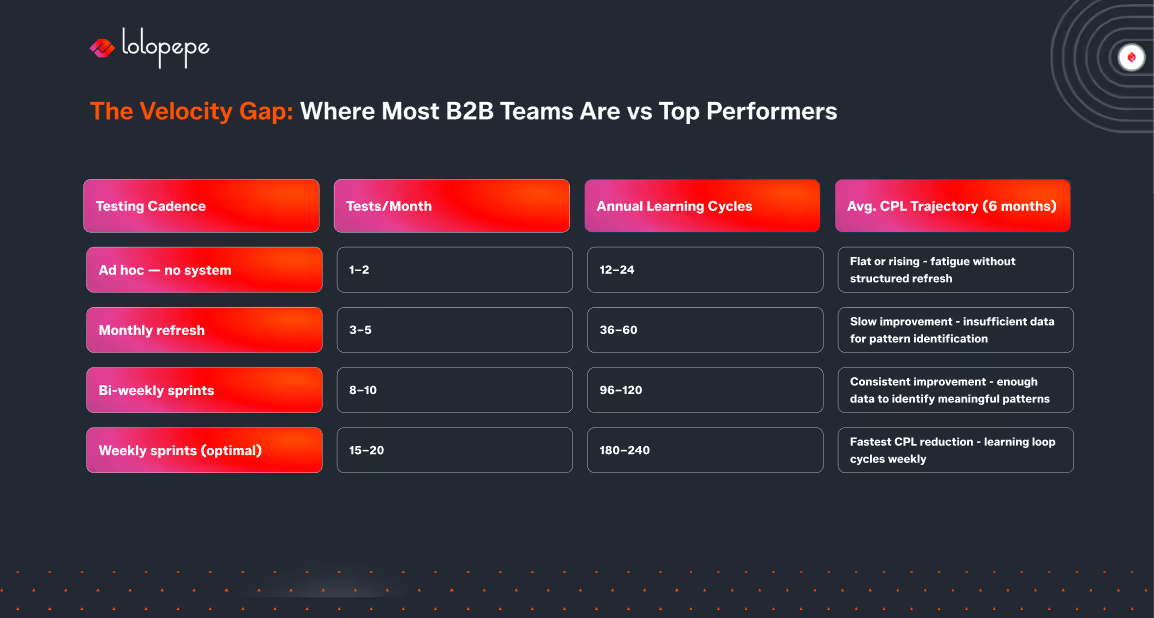
The majority of B2B advertising teams operate in the “monthly refresh” or “ad hoc” category. The velocity gap between these teams and weekly-sprint teams is not a talent gap. It is an operational gap: the weekly-sprint teams have a production system that makes 15–20 tests per month operationally feasible. The ad hoc teams do not.
How to Increase Velocity Without Increasing Budget
The budget requirement for high testing velocity is lower than most teams assume. 15 creative variants per month at $10,000/month ad spend means approximately $667 per variant per month - enough to generate statistically meaningful data within a 7-day test window at typical B2B CPM rates.
The budget constraint on testing velocity is almost never the ad spend. It is the production cost of generating 15 variants per month. Three operational changes close this gap:
1. Master brief → batch production. One master brief produces all variants for a sprint. Each variant tests a single variable against the control. The production cost per variant drops by 60-70% compared to briefing each variant separately.
2. Template-based visual production. An asset library with approved visual templates reduces per-variant design time from 2 - 3 hours to 30 - 45 minutes. The creative direction is established once; the variants are adaptations, not new productions.
3. Defined test variables, not open-ended creative. High-velocity testing is not about producing the most creative ads. It is about systematically testing one variable at a time against a control. Constraining the creative brief (test hook only, keep everything else constant) reduces the brief complexity and the production complexity simultaneously.
Batch Production as the Operational Enabler
The gap between teams with high testing velocity and teams with low testing velocity is almost always a production capacity gap. Testing 15 hypotheses per month requires 15 creative variants per month. Without a production system that delivers that volume on a reliable sprint cadence, velocity is a strategy that cannot be executed.
Ask yourself: Has your creative team spent more time debating the 'vibe' of a single image than the market spent actually looking at it? If the answer is yes, you've optimized for internal comfort, not for pipeline growth.
Batch production - producing all variants for a sprint in a single concentrated session - is what makes 15 variants per month feasible at reasonable cost.
The economics:
Sequential production: 15 variants × 4 hours per variant (brief + design + review) = 60 hours per month
Batch production: 1 master brief (3 hours) + 1 batch design session (8 hours) + 1 consolidated review (2 hours) = 13 hours per month
The 60-hour sequential production model makes high testing velocity prohibitively expensive. The 13-hour batch production model makes it feasible at $3,000–$5,000/month. The production architecture is the difference between a velocity strategy that works and one that stays theoretical.
Frequently Asked Questions
Q: How much ad spend do we need to support 15 tests per month?
A: Let's talk numbers without the fluff. To give Meta a fair shot, you need to set aside $3,000 – $5,000. Anything less isn't a 'test' - it's a gamble where you'll run out of fuel before the algorithm even finishes its morning coffee. For 15 variants per month, this requires $7,500- $ 10,500 in total ad spend. Below this spend level, reduce the variant count to 8 -10 per month and extend test windows to 10 - 14 days to achieve sufficient data volume.
Q: Can we achieve high velocity with a two-person marketing team?
A: Yes - with the right role split. One person owns the creative strategy and brief (the hypothesis development and Learning Log). One person owns production (copy and design). With a batch production model and template-based visual system, a two-person team can produce 10 - 12 variants per sprint. The constraint is not headcount - it is the discipline to run the system consistently. Two people running a disciplined sprint cycle outperform five people running ad hoc creative production.
Q: How do you prevent the velocity advantage from eroding over time?
A: The velocity advantage erodes when the production system breaks down - typically due to brief quality declining, batch production sessions being deprioritized, or Learning Log maintenance lapsing.
The structural defense: treat the sprint cadence as non-negotiable. Brief lock Monday. Production Tuesday-Wednesday. Review Thursday. No exceptions. The velocity advantage is a function of the system’s consistency, not any individual sprint’s quality.
Q: At what point does increasing test volume stop producing returns?
A: Diminishing returns on test volume begin to appear at approximately 20-25 variants per month for most B2B audience sizes. Above this threshold, individual test windows don’t receive enough impressions to generate statistically reliable data, and the learning signal degrades. The practical ceiling for most B2B teams with $10k - 30k/month in ad spend is 15 - 20 variants per month. Focus beyond this point should shift to testing quality (more precise hypotheses, better variable isolation) rather than testing quantity.
The Bottom Line
The CPL gap between the best-performing B2B advertisers and the rest is not primarily a budget gap. It is a learning velocity gap. The teams achieving the lowest CPL in B2B paid advertising are running 5–10x more creative tests per month than their competitors, closing the learning loop weekly, and compounding that learning into a creative baseline that gets better with every sprint.
Building a velocity advantage does not require a larger budget. It requires a production system that makes 15 tests per month operationally feasible - and the discipline to run that system consistently enough to let the compounding effect manifest.
The velocity advantage is durable for companies that maintain the system. It is the most defensible competitive moat available to a lean B2B growth team competing against better-funded players.
Start a 7-Day Creative Sprint for $750.
Download the Creative Velocity Calculator - input your current test cadence, ad spend, and CPL to see your projected 6-month CPL trajectory vs a high-velocity alternative.
LoloPepe’s Performance Creative Engine delivers 15 production-ready variants per month via weekly batch sprints - the operational model behind the velocity advantage.
Mirhayot Yunusov
Co-Founder at Eloqwnt | LoloPepe
Mirhayot builds design-led ventures that make impact. He specializes in turning subjective intuition into scalable Brand Operating Systems that empower Series A+ companies to ship daily.
Through his articles, Mirhayot shares the design thinking, strategic frameworks, and creative decisions behind building brands that look and feel like leaders. Whether it's brand systems, web design, or motion his insights are built from real work with real companies.
Subscribe to our newsletter.
Get valuable strategy, culture, and brand insights straight to your inbox.