

Building a Brand Content System: The Framework Fortune 500 B2B Companies Use
Enterprise content quality is a systems output. We dismantle the myth of the "huge creative team," proving how a documented framework transforms reactive chaos into a compounding engine of brand authority.

Mirhayot Yunusov
Co-Founder at Eloqwnt | LoloPepe

The marketing director scrolled through the LinkedIn feed of a Fortune 500 competitor. New content every day. Long-form thought leadership from three different executives. Product education posts. Customer stories. Platform-specific short-form. All visually consistent. All on-message. All performing.
Her first assumption: they must have a huge team. Her second assumption: we couldn’t replicate that at our scale.
The secret wasn't a hidden army of creatives or an unlimited budget. It was much simpler and much harder to replicate without discipline: they had a system. While the Marketing Director was waiting for a 'stroke of genius,' her competitor was simply running a repeatable machine that made high-quality output inevitable.
Let’s be honest: your customers don’t stop being decision-makers just because they’re scrolling at 10 PM. They just stop wanting to be lectured by a corporate brochure.
The brand content system is not a Fortune 500 exclusive. It is a framework that scales proportionally. A four-person team without one produces inconsistent, reactive content that never accumulates into authority.
Here is the framework.
DEFINITION
A B2B brand content system is a structured production framework comprising four components: content pillars (defined topic territories tied to ICP priorities), a production calendar (planned distribution of pillar content across channels and time), a governance framework (approval authority, brand standards, and quality criteria), and a production workflow (brief → production → review → publish → distribute). Without all four, content production remains reactive and inconsistent regardless of team size.
What a Brand Content System Actually Is
Most B2B teams live in a state of 'content panic' - that Sunday night realization that Monday’s LinkedIn post doesn’t exist yet. This leads to what we call 'random acts of content': posts that are occasionally brilliant but systematically invisible because they don’t build toward a single goal.
A brand content system replaces reactive decision-making with pre-defined architecture. The decisions about what to produce, when to produce it, who approves it, and how it gets distributed are made once - at the system design stage - and then executed repeatedly. The creative energy goes into execution quality, not into figuring out what to execute.
The system has four components. Each component is required. A company with strong pillars but no governance framework produces pillar-aligned content that drifts in quality over time. A company with a production workflow but no calendar produces consistent individual pieces with no cumulative strategic direction. All four components must be present for the system to function.
Component 1: Content Pillars
Content pillars are the defined topic territories your brand content operates within. They are not topics you find interesting. They are the intersection of your expertise, your ICP’s active priorities, and the positioning territory you want to own. Building content without pillars is like trying to build a skyscraper by picking out the curtains first. You might have a pretty view for a second, but the foundation won't hold the weight of your growth.
A well-designed pillar framework has three properties:
- ICP relevance: Each pillar addresses a problem, priority, or question that your target ICP is actively dealing with. Not what you want to talk about - what they need to hear.
- Competitive differentiation: At least one pillar should occupy territory your competitors are not systematically covering. The pillar that builds authority is the one where you are the most consistent, specific, and insight-dense voice.
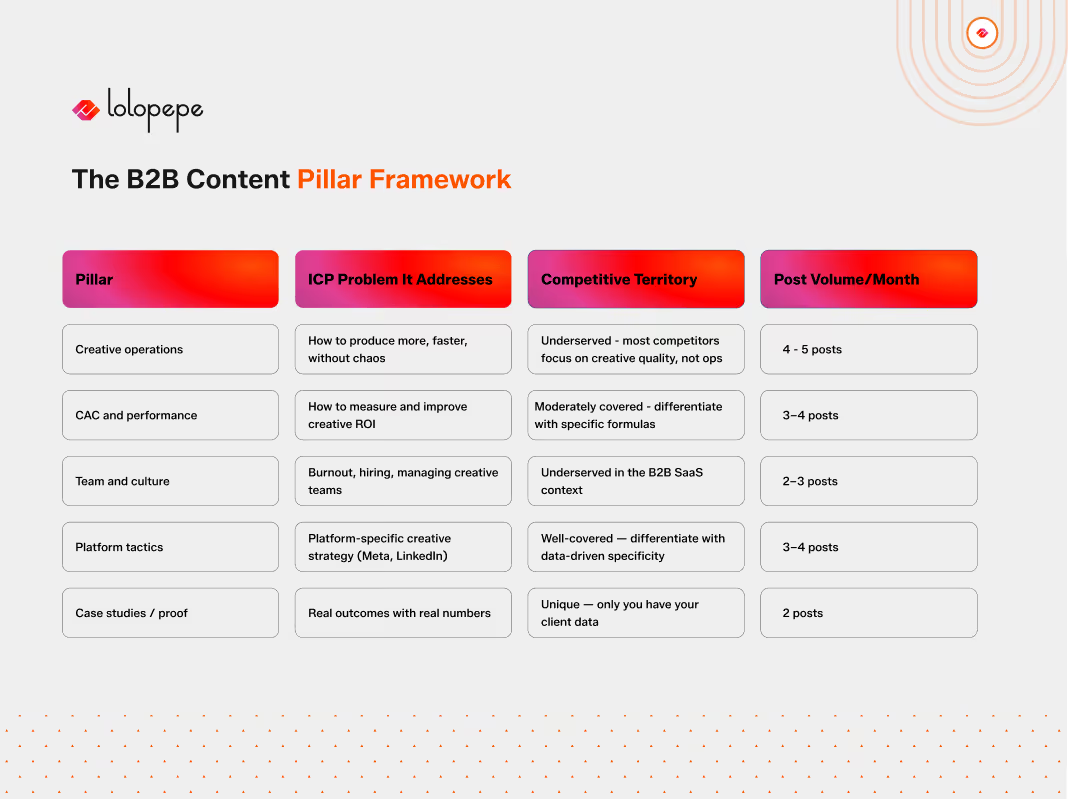
- Production sustainability: Each pillar must have sufficient depth to sustain 3 - 4 posts per month indefinitely. A pillar that exhausts itself in six weeks is a topic, not a pillar.
Example pillar framework for a B2B creative ops company targeting CMOs:
Component 2: The Production Calendar
The production calendar translates the pillar framework into a time-structured plan. It answers three questions: what gets produced, when, and for which channel.
A functional B2B brand content calendar operates on a monthly planning cycle with a two-week production sprint:
- Monthly planning session (Day 1 of the month, 60 minutes). Review last month’s performance by pillar and format. Identify the 3 - 5 highest-performing angles to build on. Plan the full month’s content slate: which pillars, which formats, which channels, which weeks.
- Sprint brief (Week 1, Monday). Lock all creative direction for the sprint’s content. One master brief covering 2 weeks of content across all channels.
- Batch production (Week 1, Tuesday - Wednesday). All content for the sprint produced in one concentrated session.
- Review and approval (Week 1, Thursday). All content reviewed against the brief in one consolidated session.
- Distribution (Week 1 - 2). Content scheduled and published across the calendar.
The production calendar makes two things true simultaneously: your content is planned strategically (it follows the pillar framework and builds toward defined authority positions), and your content is produced efficiently (batch production eliminates the overhead of individual post production).
Component 3: Governance Framework
Governance sounds like corporate red tape, but in a content system, it’s actually your greatest freedom. It’s the guardrail that ensures your brand doesn't suffer an identity crisis just because your team had a busy week. Without it, your message doesn't evolve - it just drifts.
If your CEO asked your entire marketing team 'What do we stand for?', would you get one clear answer or five different versions of 'it depends'?
A brand content governance framework has four elements:
- Brand standards document: A reference document covering tone of voice, terminology (what we say / what we don’t say), visual identity application, and messaging hierarchy. Not a 60-page brand bible - a 4-6 page operational reference that a new content contributor can read and apply within 30 minutes.
- Single approval authority: One named person with final approval on all content. Not a committee. Not a CC chain. One person. This is the most important governance decision and the most commonly violated. Committee approval produces compromise content and revision cycle inflation.
- Quality criteria: Pre-defined criteria against which content is evaluated before publication: Does it address a specific ICP problem? Does it include a specific proof point or data reference? Does it have a clear point of view? Is it free of generic language? A checklist of 5 - 6 criteria applied at review replaces subjective “I like it / I don’t” evaluation.
- Escalation protocol: What happens when content touches sensitive topics: competitive claims, customer data, product claims, executive positioning. Define in advance which content types require legal review, executive approval, or PR coordination. Undefined escalation protocols create last-minute delays that disrupt sprint cadences.
Component 4: Production Workflow
The production workflow is the repeatable process by which content moves from brief to publication. It should be documented, templated, and followed consistently enough that any team member can execute it without real-time direction.
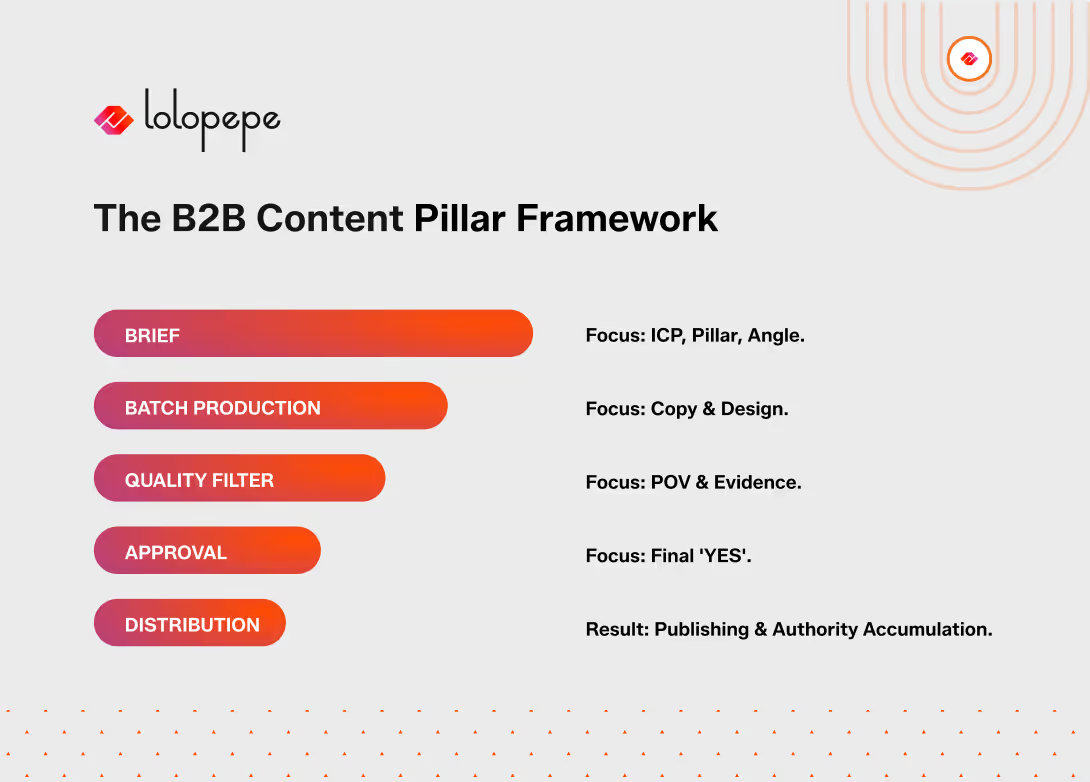
The six-stage workflow:
- Brief: Master brief created from the production calendar. Format: ICP, pillar, angle, proof points, channel specifications, success criteria. Time: 45 - 60 minutes per sprint.
- Production: Copy and design executed in batch. Copy first, design from approved copy. Time: 2 production days per sprint.
- Internal review: Content reviewed against quality criteria by a designated reviewer (not the approval authority). Issues flagged with specific references to the quality criteria. Time: 2 - 3 hours per sprint.
- Approval: Final approval session with the single approval authority. All content reviewed in one session. Time: 60 - 90 minutes per sprint.
- Revisions: Revisions applied in batch following approval session. Time: 2 - 3 hours per sprint.
- Scheduling and distribution: Content scheduled across platforms. Distribution checklist confirmed (UTMs applied, tags added, formatting verified per platform). Time: 1 - 2 hours per sprint.
The Scalability Path: From Pilot to Full System
Phase 1 - Pilot (Month 1–3): Launch with one pillar, one channel, one sprint cycle per month. Validate the workflow, identify friction points, establish the baseline performance data. Do not try to build the full system in Month 1.
Phase 2 - Expansion (Month 3–6): Add a second pillar and a second channel. Refine the governance framework based on what you learned in Phase 1. Begin building the asset library from the Phase 1 content.
Phase 3 - Full System (Month 6–12): All pillars active. Full channel distribution. Monthly planning cycle institutionalized. Asset library actively reducing per-sprint production time. The system is operating independently of any individual team member’s presence.
Phase 4 - Optimization (Month 12+): Pillar performance data drives pillar evolution. Underperforming pillars are refined or replaced. The governance framework is updated as brand positioning evolves. The system becomes self-improving.
Frequently Asked Questions
Q: How many people do you need to run a brand content system?
A: The minimum viable team is two people: a content strategist (owns the brief, the calendar, and the governance framework) and a content producer (executes copy and design). One person can run a simplified version of the system if they have strong brief discipline and batch production habits - but the review and approval component requires at least two people to function (producer and approver cannot be the same person without quality degradation). Many mid-market companies in the $3M - 10M ARR range supplement a one-person internal strategist with a productized production partner for execution volume.
Q: How do you prevent the content system from becoming rigid and formulaic over time?
A: The monthly planning session is the system’s adaptation mechanism. It reviews performance data, identifies what’s working and what isn’t, and updates the production slate accordingly. Pillars are not permanent - they are reviewed quarterly against ICP relevance and competitive positioning. The governance framework enforces quality standards, not creative constraints. A system that is confused with formulaic production has lost its monthly review discipline.
Q: We already have a content calendar. Does that mean we have a content system?
A: A content calendar is one component of a content system - the scheduling layer. Without content pillars (strategic direction), a governance framework (quality consistency), and a production workflow (operational repeatability), a calendar is a publication schedule, not a system. The difference is visible in the output: a calendar produces posted content. A system produces accumulated brand authority.
Q: How long before the brand content system produces measurable business outcomes?
A: Authority-driven outcomes (inbound DM rate, profile visit-to-follow rate, sales cycle length reduction from warm inbound) are typically measurable at 90 - 120 days of consistent system operation. Engagement metrics (post reach, share volume) are measurable within 30 days. The 90 - 120 day window is the minimum commitment for evaluating whether the system is producing the right audience signals. Brand authority is like a gym habit. One viral post is just a lucky day at the rack. A content system is the 6 AM workout that actually changes your physique over 90 days.
Companies that evaluate at 30 days and conclude the system “isn’t working” are measuring the wrong metrics on the wrong timeline.
The Bottom Line
The giants of the industry didn't win because they hired every genius on the market. They won because they built a machine where 'good' is the baseline, and 'consistency' is the default. Authority isn't a gift, it's the compound interest of a system that refuses to be boring or late.
They produce more consistent, authoritative content because they have better systems: defined pillars, structured calendars, governance frameworks that maintain quality at scale, and production workflows that operate independently of individual inspiration.
The same system architecture is available to mid-market B2B companies. The scale is smaller. The structure is identical. The output quality - and the authority it builds over time - is equivalent.
Enterprise content quality is not a budget output. It’s a systems output.
Download the Brand Content System Blueprint - a structured template covering pillar framework, production calendar format, governance checklist, and production workflow documentation.
Or book a Brand Content Audit - a 60-minute session to assess your current content architecture and identify the highest-leverage system components to build first.
Mirhayot Yunusov
Co-Founder at Eloqwnt | LoloPepe
Mirhayot builds design-led ventures that make impact. He specializes in turning subjective intuition into scalable Brand Operating Systems that empower Series A+ companies to ship daily.
Through his articles, Mirhayot shares the design thinking, strategic frameworks, and creative decisions behind building brands that look and feel like leaders. Whether it's brand systems, web design, or motion his insights are built from real work with real companies.
Subscribe to our newsletter.
Get valuable strategy, culture, and brand insights straight to your inbox.