

The Creative Operations Playbook: The End-to-End Framework for Systematic B2B Creative
This playbook installs the "Intelligence Engine" required to shift from ad-hoc chaos to a predictable system that compounds learning with every sprint. Choose between a twelve-month in-house build or buying Stage 2 maturity today to turn creative guesswork into scalable growth finally.

Mirhayot Yunusov
Co-Founder at Eloqwnt | LoloPepe

Most B2B marketing teams don't have a creative operations problem. They have a creative operations absence.
They have talented people producing good work but no consistent process connecting brief to delivery. No shared tools enforcing quality standards. No governance framework maintaining brand consistency across channels. No feedback loop turning campaign data into better creative decisions.
The result: output is unpredictable, quality varies by person and by week, and every quarter feels like starting from scratch rather than building on what came before.
This playbook provides the complete creative ops framework - roles, workflows, tooling, governance, and the maturity model that shows you exactly where you are and what to build next.
WHAT IS CREATIVE OPERATIONS?
Creative operations is the systematic management of how creative content is planned, produced, approved, distributed, and measured. It covers four domains: People (roles and capacity planning), Process (intake, production, approval workflows), Tools (project management, asset management, analytics), and Governance (brand standards, quality control, version management). When all four are functioning, creative output becomes predictable enough to plan against - and measurable enough to improve.
The Creative Ops Maturity Model
Before building anything, you need to know where you are. Most B2B organizations fall into one of three stages.
Stage 1: Ad Hoc
Symptoms: Stage 1 is the 'Artisan Workshop' - charming but unscalable. Stage 2 is the 'Assembly Line' - predictable and repeatable. Stage 3 is the 'Intelligence Engine' - where every asset produces data that builds the next one. Most teams are stuck in the workshop, wondering why they can’t build a skyscraper with hand tools.
Cost of Stage 1: 3 - 5 hours of senior marketer time per week managing creative chaos. Creative quality that varies with individual output rather than improving over time. A CAC that stays flat or rises because the creative system isn't learning.
What to build next: Basic process infrastructure - brief templates, a project management tool, a defined approval workflow.
Stage 2: Systematized
Symptoms: Standardized intake process. Project management tool tracking all requests. Defined production timelines with SLAs. Clear approval workflow with capped revision rounds. Centralized asset library with consistent naming. Basic performance reporting linked to creative decisions.
Outcome of Stage 2: You can forecast creative output for the next sprint. New team members can understand project status without asking. Campaign data informs the next brief. Quality is consistent because standards are documented.
What to build next: Closed learning loops, creative testing frameworks, strategic capacity planning against business objectives.
Stage 3: Optimized
Symptoms: Every campaign generates learning that directly improves the next cycle. The asset library is actively curated - assets are tagged, versioned, and tracked for performance. Creative decisions are hypothesis-driven with documented rationale. CAC trends downward quarter over quarter.
Outcome of Stage 3: Creative is a strategic function that reports to business outcomes - pipeline, CAC, close rate - not just output volume. The system compounds: each sprint is more effective than the last because it builds on what the previous ones learned.
Most B2B companies operate at Stage 1. Moving to Stage 2 is the highest-ROI investment in creative infrastructure. Stage 3 is where productized systems like LoloPepe operate by default - it's built into the model, not something that needs to be layered on afterward.
The Core Framework: Roles and Responsibilities
A functional creative ops team needs these roles covered. They don't all need to be separate people at smaller organizations - but the functions must be owned.
Hiring a senior designer without a creative ops process is like putting a Ferrari on a gravel road. You’ve paid for the speed, but the environment won’t let them shift past second gear. To get the performance you’re paying for, you need the operational infrastructure to match the talent.
.png)
At early Stage 2, the Creative Strategist and Creative Ops Manager roles are often combined. At Stage 3, they separate - strategy and operations require different attention at scale.
The Production Workflow: Intake to Delivery
The sprint-based production cycle is the operational heartbeat of a systematic creative function. In a Stage 2 system, a brief isn't just a document; it's the first domino. When it falls correctly, production, QA, and delivery follow in a predictable sequence. When the brief is weak, the dominoes scatter, and your team spends the week picking them up instead of moving forward.
- Brief Intake (Day 1) - Standardized brief submitted via project management tool. Fields: campaign objective, target audience, platform/format, angle hypothesis, success metrics, deadline.
- Brief Review & Approval (Day 1) - Creative Strategist reviews brief for completeness. Gaps identified and resolved before production begins. No underbriefed work enters the production queue.
- Concept Development (Day 2) - Creative Strategist develops angles and concepts. Presented to requester for directional approval - not execution approval. One round of directional feedback before production.
- Batch Production (Days 3 - 4) - Designer and Copywriter produce all assets in parallel. Batch production principle: all assets for a given brief are produced in one continuous session. Context switching between briefs is prohibited during batch windows.
- Internal QA (Day 4) - Creative Ops Manager reviews all assets against brand guidelines, brief requirements, and platform specs before client/stakeholder review.
- Stakeholder Review (Day 5) - Maximum two rounds of revision. Revision scope is defined in the brief - no 'move the logo' requests allowed after concept approval.
- Delivery & Data Setup (Day 5 - 6) - Final assets delivered to requester with UTM parameters, platform specs confirmation, and performance tracking setup. Assets archived in the asset library with campaign metadata tags.
THE DATA REVIEW PRINCIPLE
Every sprint ends with a data review - not a production retrospective. The question is not 'how did production go?' but 'what did the data tell us about what works?' Findings from each sprint's data review become the input brief for the next sprint. This is the feedback loop that makes the creative system improve over time rather than just repeat.
The Tools Stack
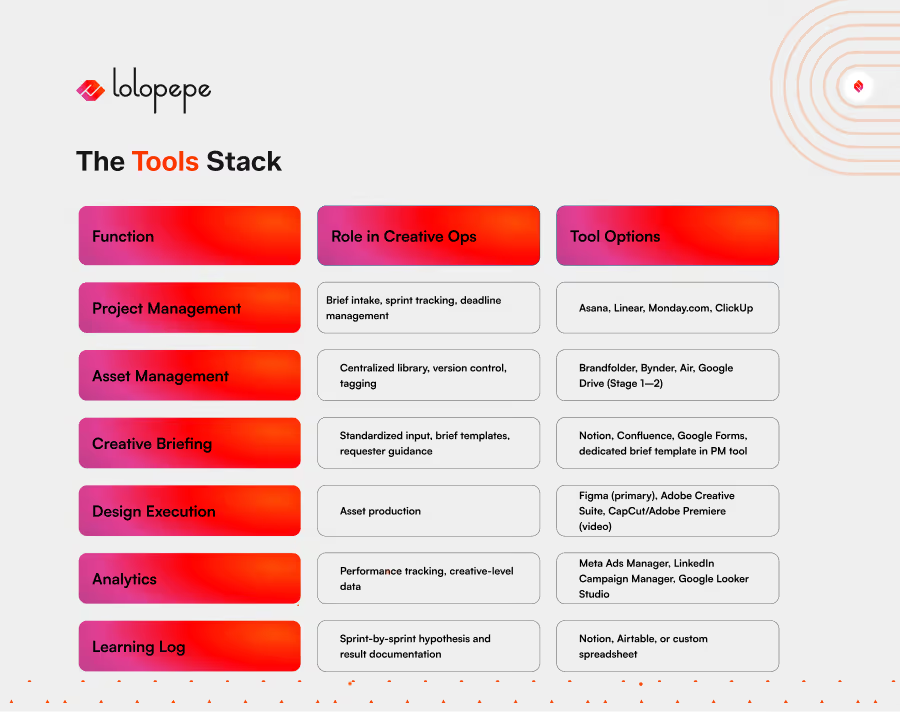
Tool selection matters less than tool adoption. A Stage 1 team with Asana they use consistently outperforms a Stage 1 team with a sophisticated stack they use inconsistently. Start with the minimum viable tooling for your current maturity stage and add complexity as the process stabilizes.
Build vs. Buy: The Decision Framework
The most important creative ops decision for a scaling B2B company is whether to build the system in-house or engage a productized service. The answer depends on your current maturity, your growth stage, and your management bandwidth.
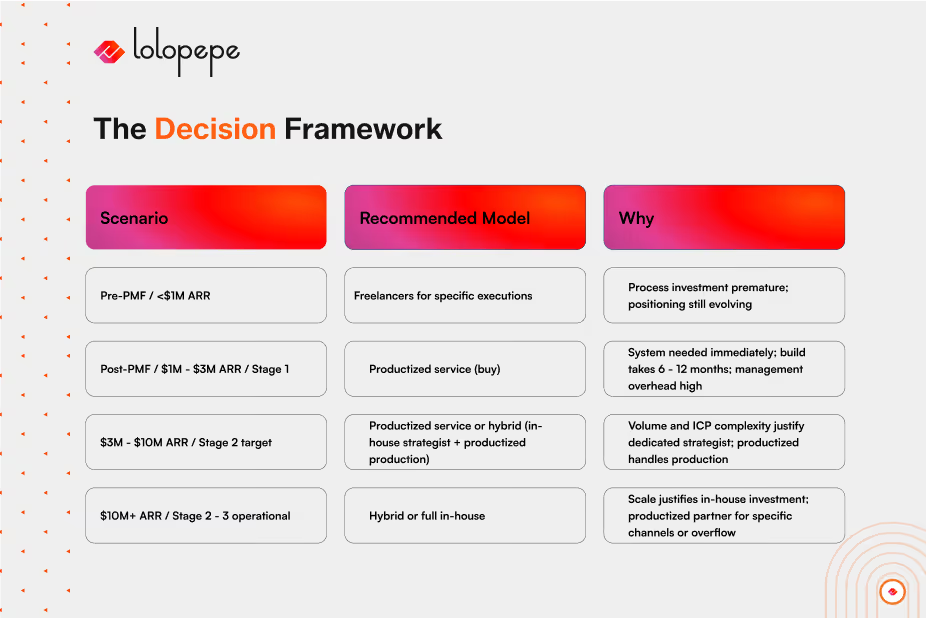
The build option at Stage 1 → 2 transition requires: process documentation (2 - 3 months), tool selection and setup (1 month), hiring or role reallocation (1 - 3 months), and a 3 - 6-month learning period before the system operates reliably. Total timeline: 6–12 months.
Building Stage 2 in-house takes 6-12 months and thousands in management overhead. Buying it - through a productized system like LoloPepe - takes one onboarding call. You can spend a year documenting processes, or you can book a 7-day Creative Sprint for $750 and have a functional Stage 2 engine running by next Friday. The choice is between 'building the tool' and 'doing the work'.
Frequently Asked Questions
What's the difference between a creative team and creative operations?
A creative team produces assets. Creative operations is the infrastructure that determines how reliably, consistently, and measurably that production happens. You can have a talented creative team without creative operations - the result is unpredictable output, quality variance, and no learning loop. Creative ops make the team's output predictable and improvable.
How long does it take to build a Stage 2 creative ops system in-house?
For a B2B company building from scratch: 6-12 months to reach a functioning Stage 2 state - process documentation, tool setup, team alignment, and the learning period required before sprints become reliable. The first 90 days are typically the hardest because existing workflows continue while the new system is being built alongside them.
How many people does a creative ops function need?
At Stage 2, the minimum effective unit is: one Creative Strategist (owns brief quality and learning loop), one Designer, and one Copywriter. That's three roles - though at smaller companies, strategist and ops manager functions are often combined. The Stage 2 system is designed for this unit - the goal is to maximize output per person through process, not to add headcount.
What's the most common mistake when building creative ops?
Starting with tools instead of process. Teams buy a DAM (digital asset management system) before they have consistent naming conventions. They set up a complex PM workflow before the basic brief template is agreed. The most valuable early investment is in the process documentation - the tool is only as useful as the process it serves.
The Bottom Line
The gap between a B2B marketing team that produces inconsistent creative and one that produces systematic, measurable, improving creative is not talent. It's infrastructure.
The playbook exists. The maturity model is clear. The roles, workflows, tools, and governance framework are all implementable - either by building them in-house over 6 - 12 months, or by engaging a productized service that delivers the Stage 2 operating model from Sprint 1.
Systematizing your creative ops isn't a project for next year; it's the barrier between your current revenue and your next milestone. Every week you spend in Stage 1 is a week of wasted 'creative velocity.' Stop fighting the current. Build the boat, or hire the crew that already has one.
Download the Creative Ops Maturity Self-Assessment
A one-page diagnostic tool: identify your current stage and the highest-ROI next step.
Or book a Creative Ops Audit with LoloPepe - 30 minutes, no pitch, just a clear diagnosis.
Mirhayot Yunusov
Co-Founder at Eloqwnt | LoloPepe
Mirhayot builds design infrastructure for founders who have no time for fluff. He specializes in turning subjective intuition into scalable Brand Operating Systems that empower Series B+ companies to ship daily.
Through his articles, Mirhayot shares the design thinking, strategic frameworks, and creative decisions behind building brands that look and feel like leaders. Whether it's brand systems, web design, or motion his insights are built from real work with real companies.
Subscribe to our newsletter.
Get valuable strategy, culture, and brand insights straight to your inbox.