

Creative Governance for B2B Brands: The Framework for Consistency Without Control
Brand inconsistency isn't a design problem - it's a systems problem. Here's the creative governance framework that B2B companies use to scale content without losing brand coherence.

Mirhayot Yunusov
Co-Founder at Eloqwnt | LoloPepe

Open your LinkedIn, your latest Meta ad, and your website. Put them side-by-side. If you didn't see the logo, would you know they belonged to the same family?
For most B2B brands at scale, the result is a 'Brand Frankenstein' - a collection of parts that are technically correct but emotionally disconnected. It’s not a lack of talent. It’s a failure of the system. Governance is the thread that keeps the monster from falling apart.
WHAT IS CREATIVE GOVERNANCE?
Creative governance is the framework that enables B2B brands to scale content production across teams, channels, and vendors without losing visual or messaging consistency.
It covers four components: brand standards documentation, approval workflows, asset management systems, and governance metrics. The goal is flexibility within a defined framework - not rigid control.
Why Brands Become Inconsistent at Scale
Brand inconsistency at scale has identifiable causes - not just 'people doing different things.' Understanding the root cause determines the right governance response.
Multiple contributors with no shared reference. A three-person marketing team can informally maintain brand consistency - they work in the same environment and calibrate to each other daily. Add five freelancers, an agency, a regional team, and an in-house designer hired six months after the others, and informal calibration fails. Without a documented standard, every contributor produces their interpretation of the brand.
Channel proliferation without adaptation guidance. A brand guide written for the website doesn't automatically tell a designer how to handle a 9:16 Meta Stories ad or a LinkedIn Document carousel. Without format-specific guidance, designers make judgment calls - and judgment calls vary.
Approval processes that approve individual assets, not consistency. Most B2B approval workflows ask 'does this meet our quality standard?' - not 'is this consistent with what we published last week?' Consistency requires a different review question.
Asset fragmentation. When approved assets live in multiple locations - a designer's hard drive, a shared folder, an email chain - contributors can't find the canonical version of a template. They recreate rather than adapt, and the recreation is always slightly different.
THE BUSINESS CASE FOR CONSISTENCY
Consistent brand presentation across all platforms increases revenue by up to 23%
Inconsistent branding is like acoustic noise for your buyer. Every time your visual language shifts, the buyer’s brain has to work harder to recognize you.
Consistent governance removes that friction, turning your marketing from a series of disjointed shouts into a clear, resonant signal that builds trust with every touchpoint.
B2B buyers who recognize your brand require fewer touchpoints to convert. And brand-consistent creative outperforms brand-inconsistent creative in A/B tests at statistically significant rates - because recognition builds trust faster than novelty.
Governance vs. Control: The Distinction That Makes It Work
The reason most B2B companies under-invest in brand governance is that they conflate it with control, and control feels like bureaucracy that slows creative production.
This is the wrong model.
Control is a centralized approval system where every asset must pass through one gatekeeper before it can be used. Control is slow, creates bottlenecks, and produces exactly the bureaucratic drag that makes governance unpopular.
Think of governance not as a cage, but as a perimeter fence around a garden. Control is having a guard stand over every gardener’s shoulder, approving every seed. Governance is simply building the fence. It defines where the garden ends and the wilderness begins.
Once the fence is up, your creators can run, plant, and experiment freely because they know they’re always on safe ground. Governance doesn't slow you down; it gives you the confidence to go faster.
The goal of creative governance is not to review everything. It's to build the shared understanding that makes review unnecessary for standard production, reserving approval workflows for non-standard, high-visibility, or high-risk creative.
The Four Pillars of Creative Governance
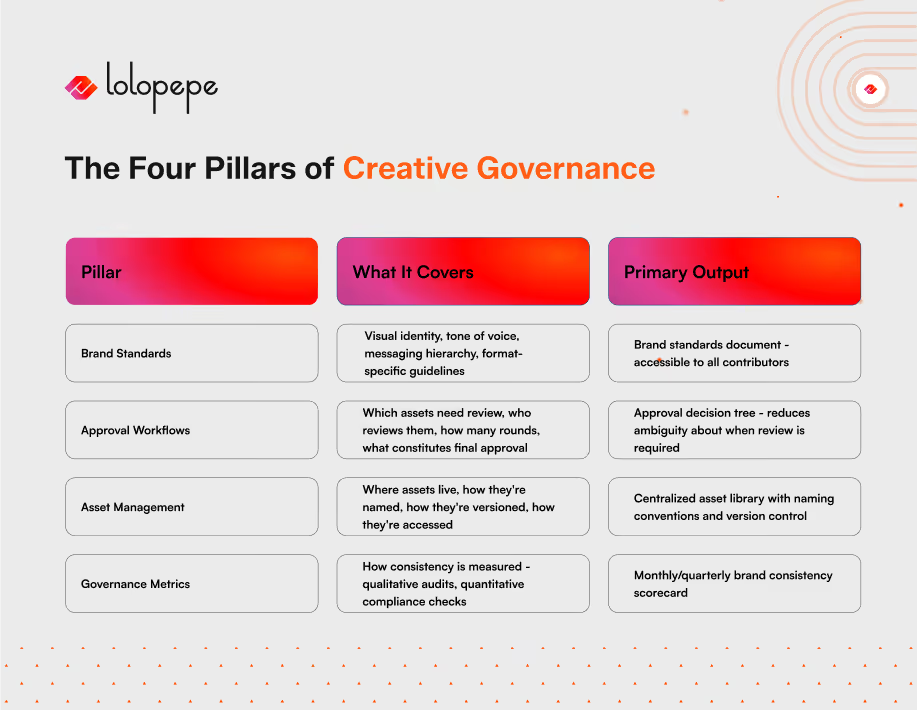
Building Your Brand Standards Document
A brand standards document that actually gets used is different from one that sits in a Notion page and is referenced twice per year. The key is specificity - not 'use our brand colors' but 'Deep Navy #002B5C is the primary background color for digital ads. It cannot be used as a text color on any surface below 32px.'
What your B2B brand standards document must include:
- Color system - Primary, secondary, and accent colors with exact HEX/RGB/CMYK values, and specific usage rules per context (backgrounds, text, CTAs, borders).
- Typography - Primary and secondary typefaces, approved size hierarchy (H1, H2, H3, body, caption), minimum sizes for digital, and print equivalents.
- Logo usage - Approved versions (full color, reversed, monochrome), minimum size, clear space rules, forbidden treatments (no drop shadows, no distortion, no unapproved color variants).
- Tone of voice - Three to five tone parameters with examples of on-brand and off-brand language. Include a 'words we use / words we avoid' list.
- Imagery and photography - Style description (lifestyle vs. graphic vs. data visualization), approved and forbidden image types, filter/treatment guidance.
- Format-specific guidelines - At minimum: social media (per platform), digital advertising (per platform), email headers, and presentation templates. For each: approved layouts, text density rules, CTA treatments.
Format-specific guidelines are the most commonly missing section and the most commonly needed one. Generic brand guidelines don't tell a designer how to handle a 300×250 display banner - format guides do.
The Approval Workflow: Designed for Speed
An effective approval workflow routes assets to review based on risk level - not by default for everything. A great governance framework acts like an autopilot system.
For 90% of your production, the system keeps the plane on course without human intervention. You only need the 'pilot' (Creative Director) to take the controls during turbulence or for a complex landing.
If your leadership is approving every social post, your plane is too heavy to fly.
.avif)
The principle: define the routing rules before a single asset enters review. When contributors know in advance which path their asset will follow, they brief themselves correctly and don't over-produce assets that will need heavy revision.
Uncertainty about the process is what creates the 12-round revision cycles that make governance feel slow.
Asset Management as Governance Infrastructure
Governance without a functioning asset library is theoretical. The library is where governance lives - it's the system that makes approved assets findable, adaptable, and consistently deployed rather than recreated.
Naming conventions - the foundation of a usable library:
NAMING CONVENTION STRUCTURE
[Brand]_[Channel]_[Format]_[Campaign]_[Version]_[Date]
Example: LP_Meta_1080x1350_Q1Performance_V3_2026-03
Rules:
• All lowercase except brand acronym
• No spaces — use underscores
• Dates in YYYY-MM format for sortability
• V1, V2, V3 for iteration versioning
• 'FINAL' reserved only for assets approved for live deployment
A digital asset library without naming conventions isn't an archive; it’s a digital graveyard. Your team spends 20% of their week playing detective, hunting for the 'final_final_v2' logo.
Governance turns that graveyard into a Shared Memory, where the right tool is always exactly where you left it.
Versioning policy:
All iterations are preserved - nothing is deleted. Superseded versions are moved to an 'Archive' folder, not deleted. This policy supports the Learning Loop principle: the ability to compare V1 to V5 performance requires that V1 still exists in the library with its metadata intact.
Measuring Governance Effectiveness
Creative governance that isn't measured is creative governance that drifts.
Use these indicators:
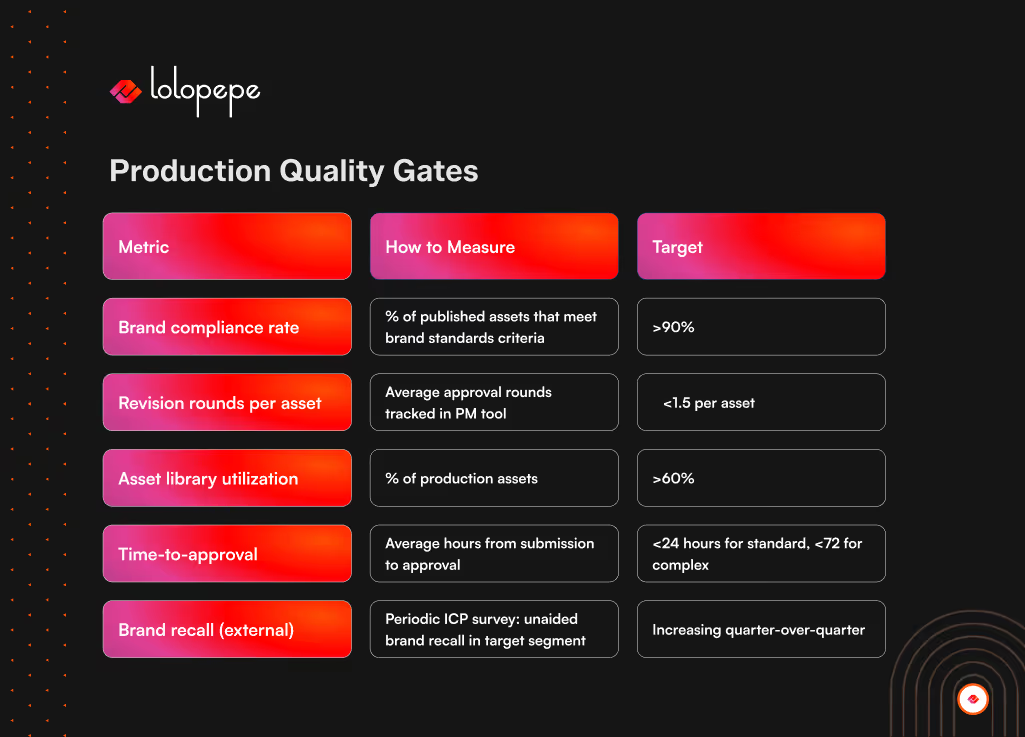
Brand compliance rate and revision rounds are the most actionable leading indicators. If compliance rate drops below 80%, governance documentation needs updating - either standards are unclear or contributors aren't accessing them.
If revision rounds increase above 2, the approval workflow is either under-specified (unclear what 'approval' means) or over-routed (assets that don't need review are being reviewed).
Frequently Asked Questions
Q: How detailed should a brand standards document be?
A: Specific enough that two different designers, working independently, would produce assets that look like they came from the same brand. If the standard is 'use our primary color' - that's not specific enough. If it's 'Deep Navy #002B5C as the primary background on digital ads; never as a text color on surfaces below 32px font size' - that's a standard.
Test your documentation by asking two designers who haven't worked with your brand before to produce a standard social post using only the guidelines. If the outputs look like the same brand, the standards are specific enough.
Q: Won't governance slow down production?
A: Well-designed governance accelerates production. The time lost in poorly defined processes -waiting for informal approval, producing assets that need rework, recreating templates that should already exist - consistently exceeds the time invested in building a clear governance framework.
The companies that report governance as a bottleneck almost always have an approval-heavy model (control), not a standards-and-library model (governance). The fix is to redesign toward standards and reduce mandatory review requirements.
Q: How do you govern brand consistency when using external vendors or freelancers?
A:The brand standards document is your governance tool for external contributors - not informal briefing or feedback-based correction. Every external contributor receives the brand standards document at onboarding.
All assets are produced from the approved asset library templates where applicable. Non-standard assets go through the non-template approval route. The key: external contributors must be briefed with the same rigor as internal contributors. Governance is channel- and contributor-agnostic.
Q: What's the minimum viable governance framework for a B2B company under 20 employees?
A: Three things:
1. A one-page brand standards summary (core colors, typography, tone, and logo rules)
2. A centralized asset library with a consistent naming convention
3. And a simple routing rule (standard template-based = no review; non-standard or external = one review round, one revision).
That's sufficient to maintain consistency at 20-person scale.
As the company grows and the contributor list expands, each governance component gets more detailed, but the three core elements remain the same.
The Bottom Line
Brand inconsistency at scale is not inevitable. It's the predictable outcome of scaling content production without scaling the systems that govern how that content gets produced.
Creative governance is not the enemy of creative freedom. It is the framework that makes creative freedom scalable - allowing contributors to work quickly, independently, and confidently within boundaries that protect the brand they're representing.
Build the four pillars. Document the standards specifically enough to be actionable. Design an approval workflow that routes by risk, not by default. Maintain the asset library. Measure compliance quarterly.
The brands that achieve consistency at scale don't manage it - they systematize it.
Download the Brand Governance Starter Kit
Brand standards template, approval workflow decision tree, and asset naming convention guide - all in one pack.
Or book a Creative Audit - 30 minutes to assess your current brand consistency and identify the highest-priority governance gaps.
Don't just audit your brand - systematize it.
Start a 7-Day Creative Sprint for $750 and experience how LoloPepe’s built-in governance engine maintains your brand standards at scale, without the bureaucratic drag.
Mirhayot Yunusov
Co-Founder at Eloqwnt | LoloPepe
Mirhayot builds design infrastructure for founders who have no time for fluff. He specializes in turning subjective intuition into scalable Brand Operating Systems that empower Series B+ companies to ship daily.
Through his articles, Mirhayot shares the design thinking, strategic frameworks, and creative decisions behind building brands that look and feel like leaders. Whether it's brand systems, web design, or motion his insights are built from real work with real companies.
Subscribe to our newsletter.
Get valuable strategy, culture, and brand insights straight to your inbox.