

What Is a Productized Service? (And Why B2B Companies Are Switching from Agencies)
$96,000 agency retainers often yield "pretty" assets but zero pipeline growth. The productized model replaces bespoke chaos with a "Tesla Gigafactory" for creative ops, delivering industrial velocity. Ditching the "Talk Tax" for SLA - guaranteed sprints turns budgets into predictable growth infrastructure.

Mirhayot Yunusov
Co-Founder at Eloqwnt | LoloPepe

The agency relationship ended not with a bang, but with a spreadsheet. Twelve months, $96,000, and a gallery of 'pretty' assets that did absolutely nothing for the pipeline. The CMO realized they didn't just lose money - they lost a year of growth.
The CMO sat down with the shortlist of alternatives: another agency, a couple of freelancers, maybe a hire.
Then someone mentioned a productized service.
The response: “What’s that?”
This is the most common entry point into the productized model. Not through a search. Not through a category comparison. Through frustration with the existing options and a word-of-mouth mention of something that sounds like it might be different.
This article explains what productized services actually are, how they work, why they’re structurally different from agencies and freelancers, and who they’re built for.
DEFINITION
A productized service is a service packaged and delivered like a software product: fixed scope, fixed price, defined deliverables, and a predictable timeline. Unlike traditional agency retainers (variable scope, hourly billing, slow delivery), productized services operate on sprint cycles with SLA-guaranteed output - giving clients the consistency of a product and the expertise of a specialist team.
SLA is our 'Anti-Ghosting' Policy. It means when we say Friday, we mean Friday. No excuses about 'capacity issues' or 'creative blocks.' It’s the professional predictability you expect from AWS, now applied to design
What “Productized” Actually Means
Productization is the transformation of a chaotic service into a streamlined product. Instead of endless negotiations and hourly billing, you receive a fixed result within a guaranteed timeframe.
Traditional agencies are like bespoke tailors: slow, expensive, and requiring a dozen fittings. LoloPepe is the Tesla Gigafactory. We’ve already engineered the chassis (the strategy) and the battery (the workflow). You simply choose the color and the destination. It’s custom quality delivered at industrial velocity.
We operate on a SaaS model for creative:
- Tier-based subscription: A defined volume of deliverables (e.g., 15 creatives per month).
- Fixed pricing: No hidden costs or "it depends."
- Sprint cadence: A closed-loop process (brief on Monday - assets delivered by Friday).
This is growth infrastructure where inputs, outputs, and timelines remain stable every single month.
How a Productized Service Works: The Mechanics
A productized creative service typically operates on a two to four week sprint cycle.
Here’s what each cycle looks like in practice:
- Brief and onboarding (Week 1, first month only). The creative team learns your brand, ICP, positioning, and current performance data. This is the one-time setup phase. From Month 2 onward, the brief is an update to an established direction, not a new onboarding.
- Sprint brief (Start of each sprint). A one-page document locking the creative direction for the sprint: target audience, core angle, proof points, channel requirements, and the specific hypothesis being tested. Approved in a single 60-minute session.
- Batch production (Days 2 - 3 of sprint). All assets for the sprint produced in a single concentrated session. For a 15-asset sprint, this is two production days. Assets delivered at end of Day 3 or Day 4 for review.
- Review and revision (Day 4 - 5). One consolidated review pass - all assets reviewed against the brief in a single session. One revision round included in the fixed price. This is not unlimited revisions on demand; it is one structured feedback loop per sprint.
- Delivery and launch (Day 6 - 7). Final assets delivered and launched. Performance data collection begins.
- Data review (End of sprint). Performance metrics reviewed. Learning Log updated. Next sprint brief written on the basis of what the data showed.
This cycle repeats every sprint. It is the same process, every time, for every client on the tier.
Productized vs Agency: The Structural Differences
Most B2B companies have worked with an agency at some point. The productized model is often explained in contrast to the agency model because the differences are structural - not stylistic.
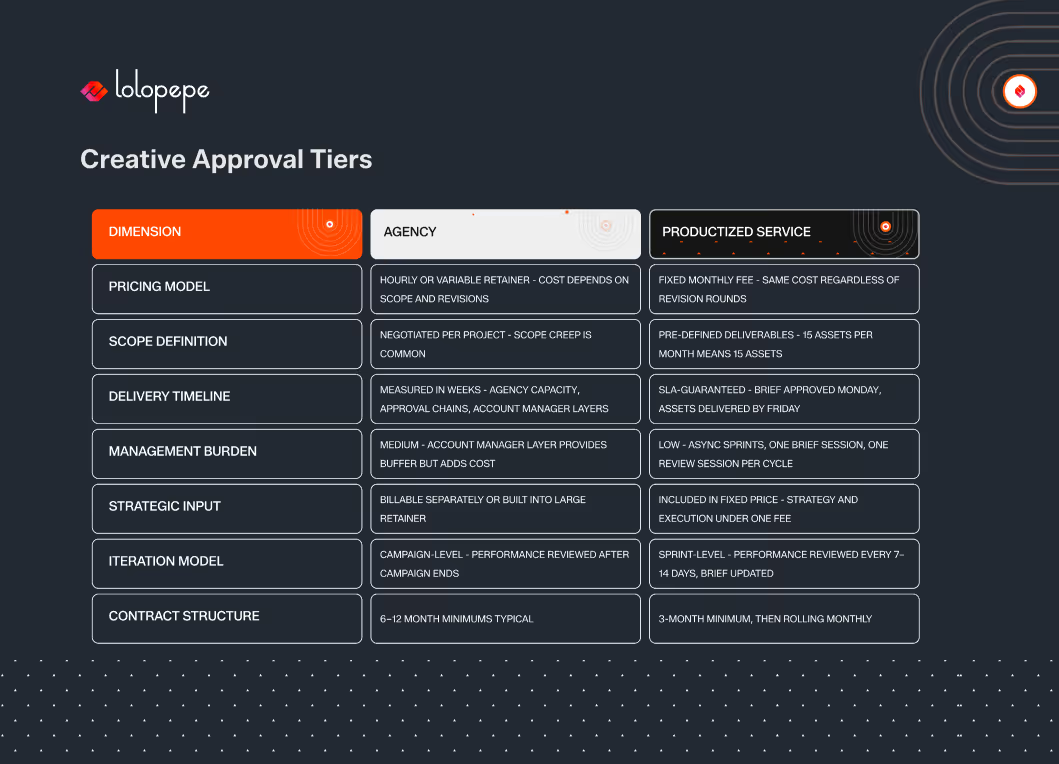
The most operationally significant difference is the iteration model. Agencies evaluate creative at the campaign level - meaning you wait until a campaign ends (typically 4 - 8 weeks) to learn what worked. Productized services evaluate at the sprint level - meaning you have actionable data every 7-14 days and the next sprint’s brief is informed by that data. Over a quarter, the number of learning cycles is 2 - 3x higher than in the agency model.
Productized vs Freelance: Why It’s Not the Same Thing
The productized model is sometimes confused with “a good freelancer.” The distinction is structural, not about individual quality.
A freelancer is a single person who executes tasks you define. You write the brief, manage the timeline, handle quality control, and re-onboard if they’re unavailable. The output depends entirely on one person’s availability, health, workload, and judgment.
A productized service is a system: a team of specialists (strategist, copywriter, designer) operating under a defined production methodology, with documented processes, SLA commitments, and institutional continuity. If a team member changes, the system continues. The brief template is the same. The sprint cadence is the same. The Learning Log is maintained. The output doesn’t depend on any single individual.
The practical difference: a freelancer is a single point of failure. If they get sick, your marketing stops. A productized service is a biological engine: even if one cell changes, the organism keeps breathing, sprint after sprint, without missing a beat.
Who the Productized Model Is For (and Who It Isn’t)
Right for you if:
- You’re a B2B SaaS or service company between $1M and $10M ARR
- You have product-market fit and are now scaling go-to-market
- You need consistent creative output - 15+ assets per month - but don’t have the management bandwidth for an in-house team
- You’ve had at least one agency or freelancer relationship that didn’t deliver on its promises
- You want to know exactly what you’re getting, exactly what it costs, and exactly when it will be delivered
Not right for you if:
- You’re pre-revenue and still finding product-market fit. At this stage, your messaging and positioning are still evolving, which makes systematic creative production premature.
- You need a major one-time production effort - a brand identity rebrand, a full website redesign, a large-scale video production. These are project-scoped engagements, not sprint-cadenced subscriptions.
- You’re at $20M+ ARR with a large marketing org. At this scale, a hybrid model (in-house brand strategy + productized execution) typically outperforms a pure productized engagement.
Why B2B Companies Are Switching: The Three Drivers
Driver 1: Delivery speed. The most common agency complaint is speed. A brief submitted Tuesday that doesn’t return for review until the following Thursday is a structural problem. It reflects an agency operating on its own capacity management timeline, not the client’s urgency. Productized services solve this with SLA: the delivery timeline is contractual, not estimated.
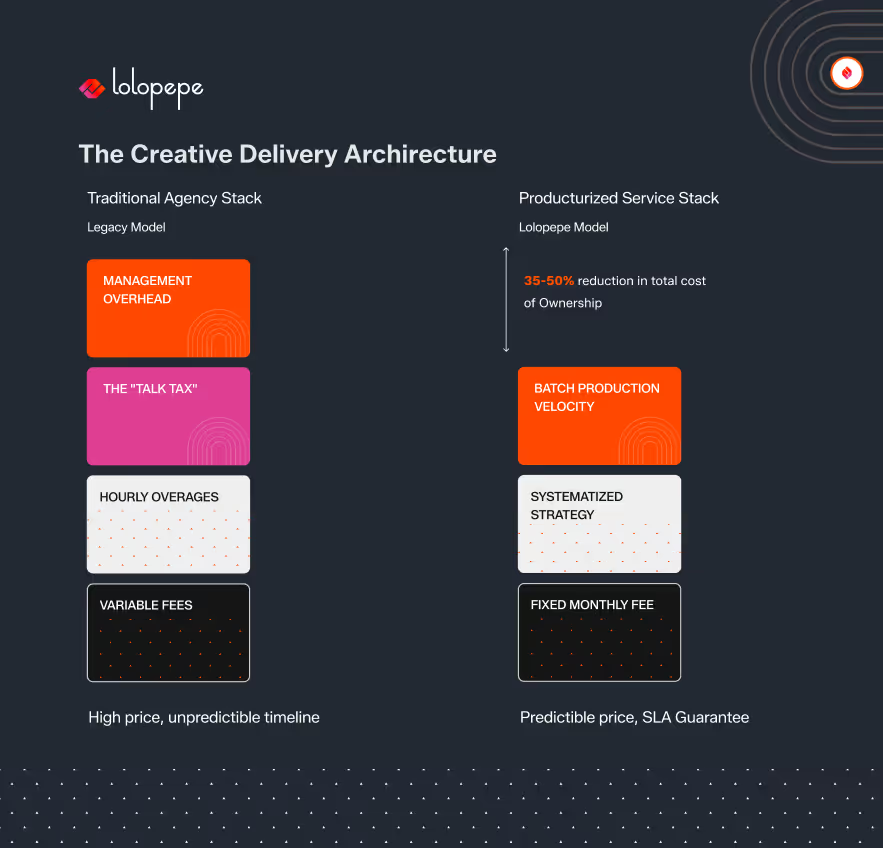
Driver 2: Cost predictability. Variable agency billing - where the invoice changes based on revision rounds, scope additions, and hourly overages - makes budget forecasting difficult and creates adversarial dynamics around scope. Fixed-price productized billing means the CFO knows the exact monthly creative investment before the month begins.
Driver 3: Management overhead reduction. Agency relationships require significant internal management: briefing, feedback coordination, approval chains, account management calls. Most agencies charge you a hidden 'Talk Tax.' You pay for account managers to manage project managers who manage the creatives. In a productized model, we burn the bureaucracy. You don't pay for meetings about work - you pay for the work itself. We communicate in sprints, not in 45-minute Zoom 'catch-ups' that could have been an email
Productized services are designed for async, low-overhead operation: one brief session, one review session, async communication between. The management burden is a fraction of a typical agency relationship.
What to Look for in a Productized Creative Service
Not all productized services are equally systematized. Four things to evaluate:
- Speed to first output. Any credible productized service should deliver sample work within 7 days of brief approval. If it takes longer, the “sprint cadence” claim is not operationally real.
- SLA specificity. A genuine SLA specifies the timeline in days, not “2 - 3 weeks.” Ask for the exact commitment: if brief is approved Monday, when are assets delivered?
- Iteration documentation. Ask how performance data informs the next sprint’s brief. If the answer is specific (“we document hypothesis outcomes sprint-by-sprint and the brief is updated based on performance delta”), the system exists.
- Asset ownership. Confirm that all source files and the Learning Log are client-owned - meaning they transfer to you if the engagement ends. In our model, every asset we build is a brick in your own fortress. You own the files, the data, and the 'Learning Log.
Frequently Asked Questions
Q: Is a productized service the same as a subscription-based agency?
A: A subscription-based agency is an agency that charges a monthly retainer, but may still operate with variable scope, hourly billing for overages, and slow approval chains. A productized service is fundamentally different in delivery architecture: fixed scope per tier, sprint-cadenced production, SLA-guaranteed delivery. The subscription model (monthly recurring payment) is the billing structure. The productized model is the delivery architecture. Some subscription agencies are productized. Many are not.
Q: How is the $500 Trial Sprint different from a free sample or pilot?
A: The $500 Trial Sprint is a full-system demonstration, not a sample. In 7 days, you receive: a brand and asset audit, approved creative angles for your ICP, 3 - 5 production-ready assets, and a 30 - 90 day growth roadmap. The $500 covers real production work. The purpose is not to give you free samples - it is to demonstrate the productized system in action against your specific brief, so the retainer decision is based on evidence, not on a sales pitch.
Q: Can we pause or cancel the retainer?
A: The standard structure is a 3-month minimum commitment, then rolling monthly. The 3-month minimum exists because the compounding benefit of the iteration model requires at least 3 sprint cycles to produce meaningful data. A 1-month engagement produces a baseline. A 3-month engagement produces a validated direction. After the 3-month period, the retainer is month-to-month with 30 days’ notice to cancel.
Q: What happens to our assets and Learning Log if we cancel?
A: Everything transfers. All source files, design assets, copy documents, and the full Learning Log are delivered to the client on retainer close. The asset library and performance documentation are client property from the first sprint. This is the “asset ownership” principle: LoloPepe builds the library on your behalf, but it belongs to you.
The Bottom Line
The productized model is not a compromise between agency and freelancer. It is not a cheaper agency or a more organized freelancer. It is a different category - one built specifically for B2B companies that need consistent, measurable, iterative creative output at a fixed cost and a predictable timeline.
The companies switching to it are not doing so because they couldn’t afford an agency. They’re switching because they ran the numbers on what the agency actually cost - in fees, in management time, in delayed campaigns, in non-iterated creative - and found that the productized model delivered more output, more consistently, for less real TCO.
The question is not whether the productized model is right for B2B creative operations. For companies in the $1M - 10M ARR range, the evidence consistently says yes. The question is whether your current setup is actually cheaper, and that requires calculating the full number, not just the sticker price.
Download the Agency vs Productized Decision Guide - a one-page framework for calculating the real TCO of your current creative setup vs the productized model.
Start a 7-Day Creative Sprint for $750. Experience the speed of a productized system on your own brand. No contracts, just evidence.
Mirhayot Yunusov
Co-Founder at Eloqwnt | LoloPepe
Mirhayot builds design-led ventures that make impact. He specializes in turning subjective intuition into scalable Brand Operating Systems that empower Series A+ companies to ship daily.
Through his articles, Mirhayot shares the design thinking, strategic frameworks, and creative decisions behind building brands that look and feel like leaders. Whether it's brand systems, web design, or motion his insights are built from real work with real companies.
Subscribe to our newsletter.
Get valuable strategy, culture, and brand insights straight to your inbox.