

LinkedIn Content Strategy for B2B: From Zero to Thought Leader in 90 Days
Identical expertise often hides a massive "authority gap": one founder earns twelve inbound DMs monthly while the other stares at a blinking cursor . We replace reactive anxiety with a rigid architecture. This roadmap builds genuine thought leadership in just four hours a month.

Mirhayot Yunusov
Co-Founder at Eloqwnt | LoloPepe

Two founders. Same industry. Same product category. Roughly equivalent expertise.
You open LinkedIn on a Wednesday morning. You know your product better than anyone, but the cursor on the blank screen just blinks back at you. You close the tab, promising yourself to write something 'smart' tomorrow. This isn't a lack of knowledge - it’s the absence of a content architecture that pulls that expertise out of your head on a schedule.
The difference isn't intelligence or expertise. Founder A is trying to build a skyscraper by simply stacking bricks whenever inspiration strikes. Founder B builds from a blueprint. While the first waits for a 'muse,' the second activates a system that works on their behalf, even while they are in board meetings.
This article is that architecture - a 90-day LinkedIn content strategy for B2B that transforms your profile into a consistent engine for qualified inbound leads.
THE THREE COMPONENTS
A B2B LinkedIn thought leadership strategy requires: content pillars (3 - 5 recurring topic areas tied to your ICP’s problems), a posting cadence (3 - 4 posts per week minimum for 90 days to build algorithm momentum), and a production system (batch-produced monthly). Without all three, LinkedIn presence remains effort-intensive and inconsistent.
Why Most B2B LinkedIn Strategies Fail Before Day 30
The failure pattern is consistent: a founder or executive decides to “do LinkedIn.” They post something thoughtful on Monday. It gets decent engagement. They post again on Wednesday.
You know the feeling: it’s Friday at 5:00 PM, you’re staring at the empty 'Start a post' field, and all you feel is irritation. The inspiration ran out on Tuesday, and LinkedIn starts to feel like a second job that doesn’t pay. This is where 90% of strategies die in silence.
LinkedIn is not a 100-meter sprint, it’s a marathon where the winner is the one who simply doesn't stop. Posting once a month is like going to the gym once a year: it’s nice for your conscience, but delivers zero results for your brand's muscles.
Three structural failures drive this pattern:
No content pillars. Without defined topic areas, every post requires starting from scratch. The cognitive load of deciding what to write about - added to the already significant task of writing well - makes consistent posting unsustainable. Pillars eliminate the “what do I write about today” problem entirely.
No production system. Posting in real time, on demand, as inspiration strikes is not a production system. It is a recipe for inconsistency. A batch production model - one dedicated session per month produces all content for the month - is the operational foundation of a consistent LinkedIn presence.
No defined success metrics. Measuring LinkedIn success by likes and impressions produces discouragement. Those metrics are vanity signals. The metrics that matter for B2B thought leadership - inbound DM rate, profile visit-to-follow rate, share volume - move on a longer timeline and require patience that most people abandon before the metrics start moving.
The Content Pillar Framework
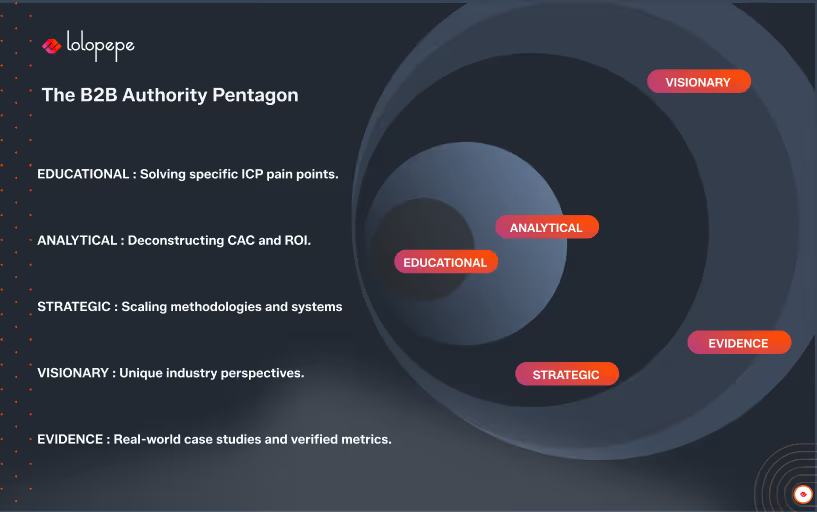
Content pillars are the 3 - 5 recurring topic areas your LinkedIn presence is built around. They are not random subjects you find interesting. They are the intersection of your expertise and your ICP’s most pressing problems.
For a B2B SaaS founder whose ICP is CMOs at Series A companies, the pillar framework might look like:
- Pillar 1: Creative operations (how to produce better creative faster - directly tied to ICP’s core function)
- Pillar 2: CAC reduction (performance frameworks, data interpretation - directly tied to ICP’s primary metric)
- Pillar 3: Team building and scaling (hiring, structure, burnout prevention - tied to ICP’s management reality)
- Pillar 4: Productized thinking (applying product principles to marketing functions - a point-of-view pillar that builds category authority)
- Pillar 5: Case studies and proof (specific client outcomes with data - social proof pillar)
Each pillar has a defined purpose: educational, analytical, point-of-view, or proof-based. The content mix across pillars prevents the feed from becoming monotonous and serves different segments of the audience at different levels of awareness.
The pillar framework also solves the content ideas problem permanently. With five pillars and four posts per week, you need 16 - 20 posts per month. That’s 3 - 4 posts per pillar per month - a volume that is easy to sustain when the topic territory is pre-defined.
The 90-Day Roadmap: Phase by Phase
Phase 1 - Foundation (Days 1-30): Define your 3 - 5 content pillars. Audit your existing expertise, writing, and IP for source material. Optimize your LinkedIn profile: headline (who you help and how), about section (ICP-specific, proof-forward), featured section (your best content or lead magnet). Produce and schedule your first month of content in one batch session. Target: 16 - 20 posts ready before Day 1. Post 4x/week. Do not measure results in Phase 1 - the algorithm needs 30 days of consistent signal before it starts distributing your content reliably.
Phase 2 - Momentum (Days 31-60): Review Phase 1 data: which posts drove the most profile visits? Which generated DMs or connection requests from target ICPs? Use this data to identify your highest-performing pillar and format. Increase production in that direction. Target: one long-form post per week (800 - 1,200 words) in addition to short-form. Begin engaging with 5 - 10 target ICP profiles per day: substantive comments (not “great post”), DMs to people who engaged with your content.
Batch Production is more than just a time-saving hack. It is the end of that daily 'Oh god, I need to post something' anxiety. You are investing 4 hours a month to purchase 30 days of peace, knowing your presence is already automated, strategically aligned, and working for you.
Phase 3 - Authority Signals (Days 61-90): By Day 60, you should have enough data to identify 2 - 3 angles that consistently generate inbound signal (DMs, connection requests, profile visits from target ICPs). Phase 3 doubles down on these angles while continuing to test the others. The inbound DM rate should begin increasing. Target by Day 90: 6 - 10 inbound DMs per month from qualified ICP profiles, 18 - 25% profile visit-to-follow rate, at least one piece of content with 50+ shares.
Posting Cadence and Format Mix
The minimum effective cadence for B2B LinkedIn authority building is 3 posts per week. Below this threshold, the LinkedIn algorithm does not develop a reliable content distribution pattern for your profile. 4 posts per week is the target cadence for the 90-day roadmap.
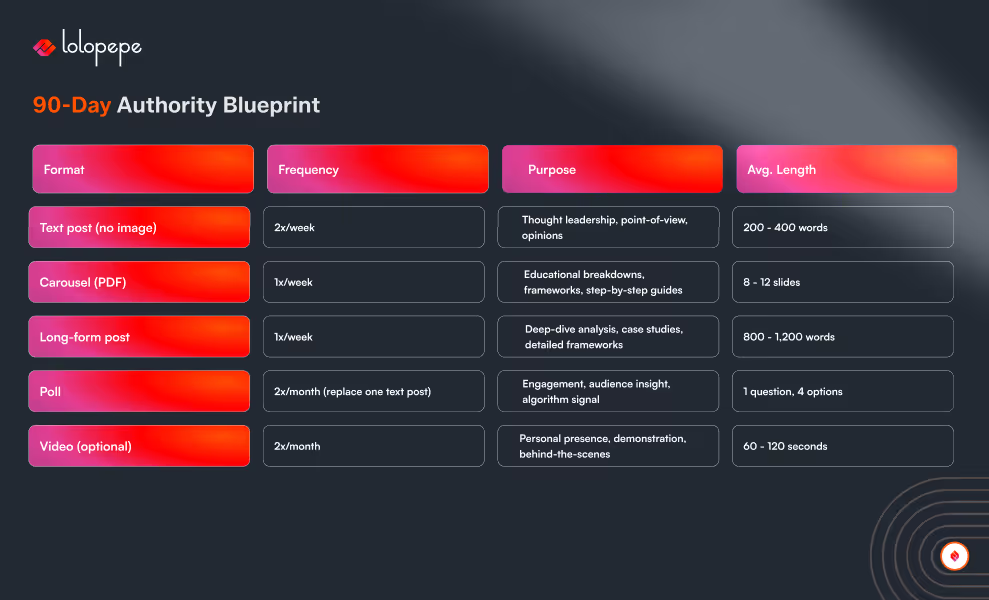
The format mix matters because different formats serve different audience segments and different algorithm signals. Carousels drive saves (a high-value engagement signal). Long-form posts drive shares. Text posts drive comments. A feed that is exclusively one format limits both reach and audience engagement depth.
The Batch Production Model for LinkedIn
Posting in real time is the enemy of consistency. Real-time posting means your content quality and volume fluctuate with your schedule, energy, and inspiration. In a busy quarter, LinkedIn posting is the first thing that gets deprioritized.
Batch production solves this permanently. One dedicated session per month - typically 3-4 hours - produces all content for the following month:
- Review last month’s performance data (30 minutes). Which posts performed? What pillar? What format? What hook structure?
- Brief the month’s content (45 minutes). For each pillar, identify 3-4 specific angles based on last month’s data and current ICP conversations.
- Write all posts (90-120 minutes). In one session, with one creative context. Same brief, same tone, same writer. Consistency is a byproduct of batch production.
- Design carousels (45-60 minutes). All carousels designed from the same template in one session.
- Schedule everything (15 minutes). Load into a scheduling tool (Buffer, Taplio, or LinkedIn native scheduler). The month is done.
Total time investment: 3.5 - 4.5 hours per month for a full month of consistent, high-quality LinkedIn content. Compared to the alternative – 30-60 minutes of anxious, reactive posting per day - batch production is dramatically more efficient and produces better output.
View Batch Production as an investment portfolio. You spend 4 hours a month to 'purchase' audience attention for the 30 days ahead. This moves you away from the need to be creative on command - you simply collect dividends in the form of inbound inquiries.
Authority Metrics: How to Measure What’s Working
Vanity metrics (impressions, likes, follower count) are not authority metrics. They measure reach and engagement, which are inputs to authority - not authority itself.
The metrics that indicate genuine B2B thought leadership authority:
Inbound DM rate: The number of unsolicited DMs per month from target ICP profiles. Benchmark at 90 days: 6-10/month. This is the most direct revenue signal on LinkedIn - people reaching out to you because of your content.
Profile visit-to-follow rate: The percentage of profile visitors who follow you. Benchmark: 18 - 25%. A high visit-to-follow rate means your profile is converting curious visitors into audience members. A low rate means visitors are arriving but not finding a compelling reason to stay.
Share volume: The number of times your posts are shared (not just liked or commented on). Shares are the strongest signal of authority content - someone found your thinking valuable enough to associate their name with it in front of their network.
Connection request quality: Track what percentage of inbound connection requests are from target ICP profiles. At early stages (Day 1-30), this percentage will be low. At Day 90 with a functioning content strategy, 30-50% of inbound connection requests should be from ICP-adjacent profiles.
Frequently Asked Questions
Q: How long does it actually take to see inbound results from LinkedIn content?
A: It takes 60 - 90 days of posting 3 - 4 times per week. The first 30 days’ build algorithm momentum, days 30 - 60 establish audience familiarity, and days 60 - 90 trigger the compounding effect that produces inbound DMs. Faster results usually imply existing audiences or exceptional luck.
Q: Do I need to post original thoughts or can I share others’ content?
A: Use original content only. Sharing others' work adds no authority signal and dilutes your content pillars. Your goal is to be the first person your ICP thinks of regarding your subject matter, which requires a unique point of view, not a curation feed.
Q: What if I’m not a natural writer?
A: Forget complex prose. Your client doesn't need Shakespeare; they need the expert who says: "I spent $50k on error X, and here is how I fixed it". Specificity beats eloquence in 10 out of 10 cases.
Q: Can this roadmap work for a company's LinkedIn page rather than a personal profile?
A: This roadmap is specifically for personal profiles. LinkedIn's algorithm deprioritizes brand content in favor of people. A founder with 2,000 followers will consistently outperform a company page with 20,000. It is the highest-leverage LinkedIn content strategy for B2B lead generation.
The Bottom Line
LinkedIn authority demands more than post volume. It requires a rigid architecture - a system that transforms your thoughts into an asset that works 24/7. It is built by posting with architecture - defined pillars, consistent cadence, batch production, and a measurement framework that tracks the metrics that actually indicate authority rather than the ones that feel good.
The 90-day roadmap is not a shortcut. It is the minimum viable commitment to see whether a systematic LinkedIn presence generates qualified inbound for your specific ICP. Most founders who complete it consistently find that it does. Most founders who attempt it without the architecture find that it doesn’t - and conclude incorrectly that LinkedIn doesn’t work for them.
The difference between those two outcomes is not talent. It is process.
Download the 90-Day LinkedIn Roadmap Template - a structured planning document with content pillar worksheet, batch production session guide, and monthly metric tracking sheet.
Start a 7-Day Creative Sprint for $750. Experience the speed of a productized system on your own brand. No contracts, just evidence.
Or book a Brand Content Audit - a 60-minute session to define your content pillars and get a custom posting strategy for your ICP.
Mirhayot Yunusov
Co-Founder at Eloqwnt | LoloPepe
Mirhayot builds design-led ventures that make impact. He specializes in turning subjective intuition into scalable Brand Operating Systems that empower Series A+ companies to ship daily.
Through his articles, Mirhayot shares the design thinking, strategic frameworks, and creative decisions behind building brands that look and feel like leaders. Whether it's brand systems, web design, or motion his insights are built from real work with real companies.
Subscribe to our newsletter.
Get valuable strategy, culture, and brand insights straight to your inbox.