
Meta Ads for B2B SaaS: Why Your LinkedIn Ads Mindset Is Killing Your Results
B2B marketers dressed in “tuxedos” at Meta backyard barbecues watch their budgets drain and corporate graphics filter in 1.7 seconds. We dismantle the LinkedIn to Meta transition, replacing rigid job targeting with a high-velocity creative system.

Mirhayot Yunusov
Co-Founder at Eloqwnt | LoloPepe

The campaign went live on a Monday. The creative: a clean, professional graphic featuring the product UI, a headline about “streamlining your creative workflow,” and a CTA button that said “Learn More.” Exactly the kind of ad that performs reliably on LinkedIn.
By Friday, the CPL was $210. The LinkedIn benchmark was $85. The growth lead’s conclusion: Meta doesn’t work for B2B.
That conclusion is wrong. Meta works exceptionally well for B2B SaaS - but only when the creative is built for Meta. The ad that launched on Monday was built for LinkedIn. It was resized, not rebuilt. And on Meta, that distinction is the difference between $85 CPL and $210 CPL.
This article is the deprogramming guide for B2B marketers making the LinkedIn-to-Meta transition. It covers what is actually different about the platforms, what those differences require from creative, and the five most common LinkedIn habits that kill Meta performance.
THE CORE DIAGNOSIS
B2B marketers running Meta ads with a LinkedIn mindset make three consistent mistakes: (1) using formal, corporate creative in an entertainment-context feed that demands pattern interruption, (2) over-relying on job-title targeting when Meta’s algorithm performs better with broad audiences and creative-driven qualification, and (3) benchmarking Meta CPL against LinkedIn CPL - when Meta typically delivers 40 - 60% lower CPL for B2B when the creative is platform-appropriate.
The Platform Mindset Difference: Why Context Changes Everything
Every platform has a user context - the mental state a user is in when they encounter your ad. That context determines what kind of creative works.
LinkedIn’s user context is professional. When someone opens LinkedIn, they are in a work-mode mental state: researching, networking, consuming industry content, managing their professional identity. They expect professional content. They are receptive to thought leadership, product information, and industry analysis. They will tolerate - and sometimes welcome - formal, information-dense creative.
Meta’s user context is entertainment. When someone opens Instagram or Facebook, they are in a relaxation and discovery mental state: watching videos, seeing what friends are doing, being entertained. They did not open the app to think about work. Your B2B ad is interrupting a leisure experience. The creative must earn the interruption.
The implication: creative that “fits in” on LinkedIn will not fit in on Meta - and creative that doesn’t fit in on Meta gets scrolled past in 1.7 seconds. Professional graphics, corporate color schemes, and formal headlines signal “work” in an entertainment context. The user’s brain filters them out.
How Meta’s Algorithm Works (vs LinkedIn’s)
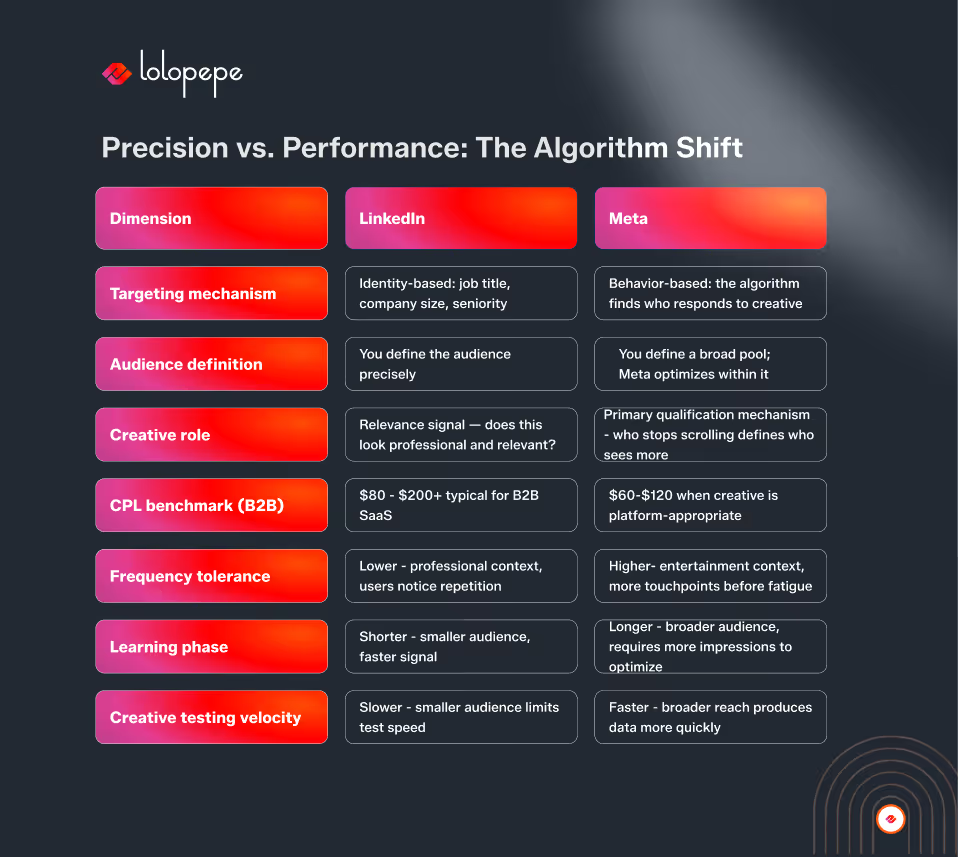
The most operationally significant difference is the targeting mechanism. On LinkedIn, you define a narrow audience and the creative serves that audience. On Meta, you define a broad pool and the creative’s performance defines which segment of that pool sees it more. The creative is doing the audience qualification work that targeting does on LinkedIn.
This is why LinkedIn creative fails on Meta: LinkedIn creative is designed to be relevant to a pre-defined audience. Meta creative needs to be compelling enough to self-select the right audience from a broad pool. These are fundamentally different creative objectives.
Creative Requirements on Meta: What Actually Stops the Scroll
The creative’s job on Meta is to interrupt an entertainment feed and immediately communicate why the next 3 seconds are worth the viewer’s attention. This requires different creative principles than LinkedIn.
Pattern interruption in the first frame. The first 1.7 seconds determine whether the user stops or scrolls. This means the opening frame of a video or the visual of a static must be immediately arresting - not through shock, but through unexpectedness. A B2B SaaS ad that opens with a professional headshot and a product logo will not interrupt. An ad that opens with a bold, unexpected statistic (“Your $800 freelancer costs $4,500/month” in large type) has a chance.
Human-first, product-second. The highest-performing B2B Meta creative speaks to the person before it speaks to the professional. “You’re paying for creative. You’re managing creative. And your CPL hasn’t moved.” This opening addresses the human experience of a frustrated B2B marketer - not their job title. The product relevance is implicit. The human relevance is explicit.
Copy length: short for statics, narrative for video. Static ads on Meta should have minimal copy - one headline, one sub-headline, one CTA. The visual does the work. Video can be longer (60 -120 seconds) if the narrative earns continued attention. A 30-second video that front-loads the most compelling moment (the hook) outperforms a 15-second video that buries it.
Specific over generic. “Scale your creative ops” is generic. “Produce 40 assets in 2 days without hiring” is specific. Specificity creates relevance in a way that generic benefit statements cannot. Every claim in a Meta creative should be as specific as the data allows.
Targeting Strategy for B2B on Meta
LinkedIn’s targeting precision is an advantage when your ICP is well-defined by professional attributes. Meta’s targeting is an advantage when your ICP is well-defined by behavior and your creative is strong enough to self-select.
Three targeting approaches for B2B on Meta:
Broad audience + strong creative (recommended for testing): Define a broad pool (age range, country, general interest categories) and let the creative qualify the audience. This approach generates the most data fastest and surfaces the true performance ceiling of your creative. Start here for new campaigns.
Custom audience retargeting (recommended for conversion): Retarget website visitors, LinkedIn engagers, and email list segments. These audiences have prior brand exposure - they are the “warm” audiences that convert at 30 - 45% lower CPL than cold. This is where your organic LinkedIn content investment pays a Meta dividend: the audience you’ve built on LinkedIn becomes your highest-converting Meta retargeting pool.
Lookalike audiences (recommended for scale): Once you have 500+ converters in your pixel, build lookalike audiences from your highest-value customer profiles. Meta’s lookalike modeling is excellent at finding behavioral patterns that predict B2B buying intent even without professional targeting data.
What to avoid: over-narrowing with interest stacking and demographic layering before you have performance data. Narrow targeting on Meta reduces the algorithm’s ability to optimize and increases CPL before your creative has been validated.
The 5 Most Common LinkedIn-to-Meta Mistakes
- Resizing LinkedIn creative for Meta. A LinkedIn ad resized to Meta dimensions is still a LinkedIn ad. The visual language, copy density, and design aesthetic are wrong for the platform. Every Meta campaign requires creative briefed and produced specifically for Meta.
- Using job-title targeting as the primary audience definition. Job-title targeting on Meta is available but produces narrow, expensive audiences that limit the algorithm’s optimization ability. Use it for retargeting overlays, not primary targeting.
- Benchmarking against LinkedIn CPL in the first 30 days. Meta’s learning phase requires 50 conversions per ad set before the algorithm exits optimization mode. CPL in the first 2 - 3 weeks is not representative. Evaluate performance at Day 30 minimum.
- Using the “Learn More” CTA for all placements. “Learn More” is the lowest-intent CTA on Meta. For bottom-of-funnel creative, test “Get Started,” “Book a Demo,” or “See How It Works.” Higher-intent CTAs with matching creative produce higher conversion rates even if click volume is lower.
- Producing one creative variant per campaign. LinkedIn campaigns can perform on a single variant for weeks because the audience is narrowly defined and the creative’s job is relevance, not interruption. Meta campaigns fatigue faster and require 3 - 5 variants per sprint to maintain performance as the algorithm finds new audience segments.
What Good B2B Meta Creative Looks Like
The highest-performing B2B Meta creatives share five characteristics:
- A specific, counterintuitive hook in the first frame. Not a product shot. A claim, a number, or a scenario that creates immediate relevance for the target ICP.
- Human language, not corporate language. Written as if one knowledgeable person is talking to another - not as if a brand is broadcasting.
- One idea per creative. Not a features list. Not a benefit hierarchy. One specific problem or outcome, communicated with precision.
- Visual contrast with the surrounding feed. If your feed is full of photography, a bold typographic creative stands out. If your feed is full of text-heavy graphics, a clean product visual stands out. The creative’s job is to be different from what surrounds it.
- A clear, friction-reduced next step. The CTA should match the temperature of the audience. Cold traffic: low-commitment CTA (“See how it works”). Warm retargeting: high-commitment CTA (“Book a demo”).
Frequently Asked Questions
Q: Is Meta actually worth it for B2B SaaS with a high ACV product?
A: Yes - when used correctly. High ACV products ($10k–$50k+ ACV) typically use Meta for top-of-funnel awareness and retargeting rather than direct conversion. The funnel looks like: Meta awareness ad → website visit → LinkedIn retargeting → email sequence → demo. Meta’s role is audience warming, not direct close. CPL benchmarks should reflect this: measure cost per qualified lead who enters the funnel, not cost per closed deal directly attributed to a Meta click.
Q: How much budget do you need to test Meta for B2B?
A: The minimum effective test budget for B2B Meta is $3,000 – $5,000 per month over 90 days. Below this threshold, the learning phase takes too long and the creative test cadence is insufficient to produce actionable data. The $3,000 – $5,000 budget should be split across 3 - 5 creative variants targeting a single conversion objective (lead generation or traffic to a landing page). Month 1 establishes the baseline. Month 2 produces the first iteration. Month 3 produces the first reliable CPL benchmark.
Q: Should we run Meta and LinkedIn simultaneously or sequentially?
A: Simultaneously - but with different roles. LinkedIn handles professional targeting and thought leadership distribution (organic + paid). Meta handles broad audience acquisition and retargeting. The ecosystem model works when both channels share a core messaging framework: the same positioning angle, different creative execution for each platform’s context. Running them simultaneously also enables the most valuable retargeting play: LinkedIn organic engagers retargeted on Meta, where CPL is typically 40 - 60% lower than cold Meta audiences.
Q: What’s the right creative refresh cadence for B2B Meta?
A: New creative variants every 7-14 days for active campaigns. B2B Meta audiences fatigue faster than consumer audiences because the target pool is smaller - the same people see the same creative more frequently. The fatigue signal: CPL rising by 15 - 20% over 5 - 7 consecutive days with frequency above 3.5 for cold audiences. When you see this pattern, new creative is the fix - not audience adjustment. A batch production sprint producing 5 - 8 new variants every two weeks is the operational model that makes this refresh cadence sustainable.
The Bottom Line
Meta works exceptionally well for B2B if you stop being boring. When your creative speaks the platform's native language, a B2B SaaS lead costs between $60 - $120.
A high $210 CPL isn't a failure of Zuckerberg’s algorithms; it’s a "lost in translation" error. Running LinkedIn ads on Meta is like wearing a tuxedo to a backyard BBQ: you look incredibly professional, but nobody wants to talk to you because you're out of place.
People go to Meta to unwind, not to work. But the secret is that your clients don't stop being decision-makers just because they’re scrolling through Reels; they just don’t want to be lectured. The solution is simple: swap corporate pathos for native content, test fast, and remember - you aren't competing with other brands; you're competing with cat videos. The first person to stop "translating" and start "building" for Meta wins the CPL war.
Download the Meta vs LinkedIn Creative Comparison Guide - a side-by-side reference covering creative specs, copy guidelines, targeting approach, and performance benchmarks for both platforms.
Start a 7-Day Creative Sprint for $750. Experience the speed of a system that understands Meta's DNA. No more burning budget on 'LinkedIn-style' failures-just high-velocity, platform-native creative that converts.
Mirhayot Yunusov
Co-Founder at Eloqwnt | LoloPepe
Mirhayot builds design-led ventures that make impact. He specializes in turning subjective intuition into scalable Brand Operating Systems that empower Series A+ companies to ship daily.
Through his articles, Mirhayot shares the design thinking, strategic frameworks, and creative decisions behind building brands that look and feel like leaders. Whether it's brand systems, web design, or motion his insights are built from real work with real companies.
Subscribe to our newsletter.
Get valuable strategy, culture, and brand insights straight to your inbox.