

Creative Burnout in B2B Marketing Teams: Warning Signs and Prevention Systems
Creative burnout is a structural failure that turns elite designers into quiet quitters. Most B2B teams treat their creatives like coal mines instead of high-performance engines, ignoring the process chaos that actually triggers departures. Fix the system before your lead designer finds the exit.

Mirhayot Yunusov
Co-Founder at Eloqwnt | LoloPepe

The senior designer handed in her notice on a quiet Tuesday. No drama, no performance issues - just a blank look in her eyes that wasn't there fourteen months ago. Her manager was blindsided, but the spreadsheet of her last 200 'urgent' tasks told a different story.
The exit interview was revealing. The designer wasn’t burned out by the volume of work. She was burned out by the chaos around it. Briefs arrived without context. Revision rounds had no defined scope. Feedback came from four directions simultaneously. She never knew whether her work was making an impact because no one ever shared the data. After fourteen months of producing creative into a void, she was done.
This is not an unusual story. It is the standard arc for in-house creative talent in B2B SaaS companies that have not systematized their creative operations. The details vary. The underlying structure is almost always the same.
Creative burnout in B2B marketing teams is not a people problem. It is a process problem - and it has a process solution.
THE STRUCTURAL DEFINITION
Creative burnout in B2B marketing teams is caused by three structural conditions: production chaos (no defined sprint cadence or deliverable scope), scope ambiguity (unclear expectations and endless revision cycles), and creative isolation (no performance data feedback, so the team doesn’t know if their work is making an impact). Addressing these three root causes - not motivational interventions - is what prevents burnout at the systems level.
What Creative Burnout Actually Is (and Isn’t)
Burnout is a state of chronic depletion caused by sustained exposure to unresolvable stress. In the context of creative work, the specific stressors that produce burnout are distinct from general workplace stress.
Creative burnout is not caused by difficult stakeholders or demanding feedback. Feedback, even critical feedback, is workable when it is timely, specific, and connected to a clear brief. Feedback that is contradictory, late, scope-expanding, or disconnected from any defined success criteria is a different experience entirely.
Creative burnout is caused by structural conditions that make competent performance impossible. When the inputs (briefs, direction, context) are consistently inadequate and the feedback (revision requests, approvals, performance data) is consistently unpredictable.
Imagine pouring your soul into a masterpiece, only to have someone ask you to 'make the logo bigger' at 5:55 PM for the tenth time. It’s not just work, it’s the erosion of professional dignity. When effort never leads to a predictable win, the human brain simply switches off.
The Warning Signs: Early, Middle, and Late Stage
Early stage (months 3 - 8): Declining creative risk-taking - the designer or copywriter starts defaulting to safe, proven formats rather than experimenting. Increasing revision round frequency on work that previously sailed through. Subtle tone shifts in communication: shorter responses, less initiative in creative direction discussions. These signs are easy to miss and easy to rationalize as “a quieter month.”
Middle stage (months 8 - 12): Visible quality degradation on work that doesn’t have direct oversight. Meeting attendance becomes perfunctory. The creative team stops flagging problems proactively - they execute instructions and stop offering input. Sick days increase. The team becomes execution resources rather than creative contributors, which accelerates the burnout cycle because the intrinsic reward of creative contribution disappears.
Late stage (months 12 - 18): Departure signals: updated LinkedIn profile, job-hunting behavior, disengagement from strategic conversations. By the time you see late-stage warning signs, the team member has typically been mentally checked out for 2 - 3 months. The resignation is the last step in a process that started much earlier.
The Three Structural Root Causes
Root Cause 1: Production chaos. No defined sprint cadence means creative work arrives on demand, at variable volume, with variable urgency. The creative team cannot plan, cannot batch, and cannot protect deep work time.
Every day starts with an unknown workload. This chronic unpredictability is one of the most reliable generators of occupational burnout in any knowledge work context.
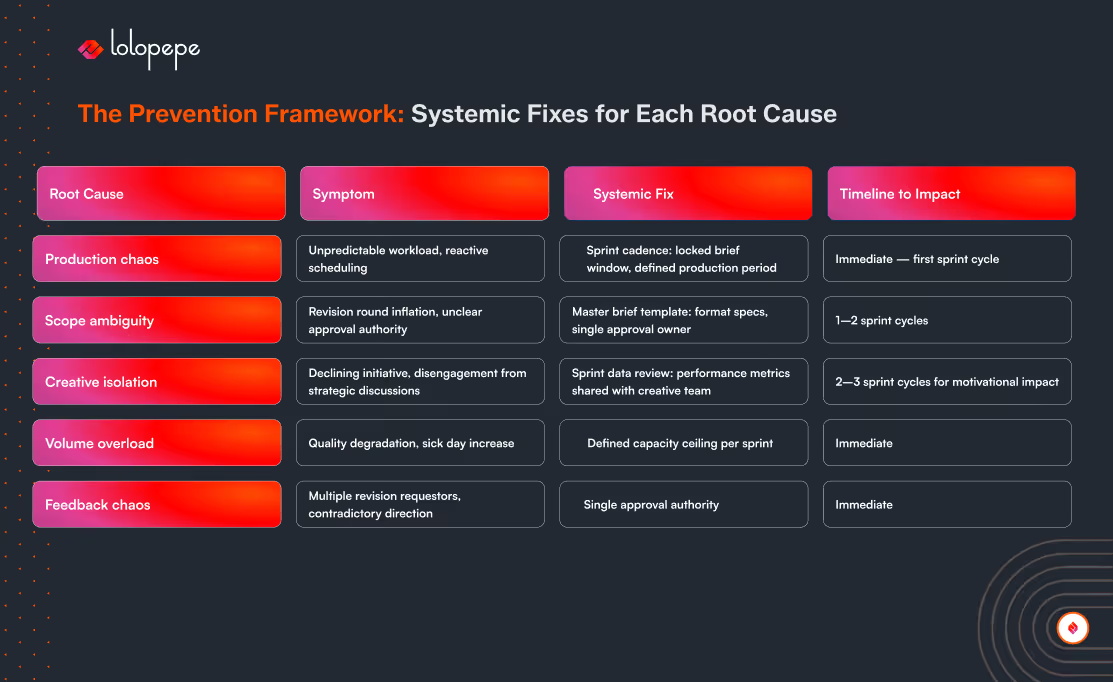
The fix is a sprint cadence: a defined production cycle with a locked brief window, a defined production period, and a defined review period. Brief lock Monday. Production Tuesday -Wednesday. Review Thursday. Delivery Friday.
The cycle is predictable. The team can plan around it. The chaos resolves. A sprint cadence isn’t just a schedule; it’s a glass wall. It protects the creative team from the 'urgent' noise of the outside world, allowing them to focus on the work while stakeholders watch the progress without interrupting the flow.
Root Cause 2: Scope ambiguity. Undefined revision scope is the single most corrosive structural condition in creative operations. When a brief says “please design an ad” without specifying format, dimensions, copy length, revision rounds, or approval authority - the creative team is working without a success definition.
Every deliverable is at risk of infinite revision. The psychological cost of never knowing when something is done is significant.
The fix is a master brief template with mandatory fields: format specifications, revision round limits, approval authority (one person, not a committee), and explicit success criteria. Not “we’ll know it when we see it.” Specific, pre-agreed criteria.
Root Cause 3: Creative isolation. When a creative team produces assets but never receives performance data - no CPL data, no engagement metrics, no information about whether the campaign drove pipeline - they are operating in a motivational void.
The intrinsic reward of seeing your work produce a measurable outcome is one of the most powerful retention factors for creative professionals. Withholding it, even accidentally, is demotivating at a deep level.
The fix is a sprint data review: at the end of each sprint cycle, performance data is shared with the creative team. Which assets performed? What did the data show? What are we changing next sprint based on what we learned?
This closes the loop and restores the connection between creative effort and measurable impact. Working without a data loop is like running a marathon in total darkness.
You’re putting in max effort, but you have no idea if you’re even on the track. Our system turns the lights on, showing the team exactly where their creative energy hit the target.
Why the 12 - 18 Month Burnout Pattern Is Predictable
The 12 - 18-month timeline is not coincidental. It reflects the typical depletion curve for creative professionals operating without structural support. Most B2B companies treat their creative talent like a coal mine - just keep digging until the walls collapse. We treat it like a high-performance engine: it needs specific fuel (briefs) and regular cooling periods (sprints) to run at redline without exploding.
Months 1-3: High motivation. The new role brings novelty, challenge, and the energy of building something. Structural problems exist but are masked by motivation.
Months 3-8: Early friction. The structural problems become visible. Revision cycles are unpredictable. Briefs are inadequate. Performance data is absent. The creative professional begins compensating with extra effort to overcome the structural deficits.
Months 8-12: Depletion. The extra effort is not sustainable. The compensation strategies stop working. Quality begins to drift. The professional begins to disengage as a self-protective response.
Months 12-18: Departure decision. The professional reaches the conclusion that the structural conditions are not going to change. The departure decision is made, and the notice follows.
The predictability of this timeline is important: it means intervention is possible at every stage. The early warning signs at months 3–8 are the most actionable intervention point - when the structural problems are visible but the professional is still engaged enough to respond to systemic change.
The Prevention Framework: Systemic Fixes for Each Root Cause
When to Bring in External Support
There are two scenarios where external creative support is the appropriate structural response to burnout risk - not a workaround for it.
Scenario 1: Volume spikes. Campaign launches, product announcements, or seasonal volume increases push the in-house team beyond their sustainable capacity ceiling. Rather than absorbing the spike internally - which accelerates depletion - a productized creative partner absorbs the overflow volume on the same sprint cadence. The in-house team maintains their sustainable pace. Quality is preserved.
Scenario 2: Skill gaps. Performance creative (Meta ads, LinkedIn ads) requires a specific skill set - hypothesis testing, CPL analysis, iteration velocity - that is distinct from brand creative. Asking brand designers and copywriters to produce performance creative without this skill set increases frustration and reduces output quality. A specialized productized partner handles performance creative; the in-house team handles brand.
The key distinction: external support should reduce the in-house team’s burden, not add coordination overhead. A productized service with a defined sprint cadence and async communication model reduces management burden. An additional freelancer relationship adds it.
Frequently Asked Questions
Q: How do I identify which root cause is driving burnout in my specific team?
A: Run a structured diagnostic with three questions: (1) Can your creative team predict their workload two weeks in advance? If no - production chaos is the primary driver. (2) Can your creative team state the specific revision scope and approval authority for any current brief? If no - scope ambiguity is the primary driver. (3) Does your creative team receive performance data from the work they produce within two weeks of launch? If no -creative isolation is the primary driver. Most teams have all three, but one is typically dominant. Fix the dominant cause first.
Q: We’ve already lost a key creative team member. How do we prevent the next departure?
A: Before re-hiring, fix the structural conditions that caused the departure. Re-hiring into the same structural environment produces the same outcome on the same timeline. The 12-18 month burnout cycle restarts with the new hire. The structural audit - sprint cadence, brief template, single approval authority, data review - should happen before the job posting goes live. Ideally, the new hire joins a team that already has the system in place.
Q: Is it possible to implement a sprint cadence with an existing team that’s already showing middle-stage burnout signs?
A: Yes - but the implementation approach matters. Don’t introduce the sprint cadence as a new management layer. Introduce it as relief: “Starting next week, briefs lock on Monday and nothing new enters production mid-week. Your production window is protected.” The sprint cadence is experienced as protection from chaos, not as additional structure. Teams in middle-stage burnout typically respond positively within 2–3 sprint cycles when the chaos reduction is tangible.
How do you prevent burnout in a productized creative model?
A: The productized model is structurally resistant to the three root causes of creative burnout by design. The sprint cadence eliminates production chaos. Fixed-scope deliverables eliminate scope ambiguity. The sprint data review closes the creative isolation loop. The capacity ceiling - a defined maximum asset count per sprint - prevents volume overload. These are not cultural interventions; they are operational constraints built into the production architecture. Burnout is not eliminated as a possibility, but it is made structurally improbable.
The Bottom Line
Creative burnout is predictable, diagnosable, and preventable. It is not a function of how hard your team works or how demanding your stakeholders are. It is a function of whether your creative operations have the structural conditions that make sustained, high-quality work possible.
The three structural conditions - a sprint cadence, defined scope, and a performance data loop - are not complex to implement. They are discipline to implement. The companies that do it consistently do not lose creative talent at 14 months. They retain it at 36 months and beyond - because the system makes the work sustainable.
The goal is not a team that never burns out. It’s a system that makes burnout structurally improbable.
Download the Creative Team Health Checklist - a structured diagnostic covering all five structural risk factors with a scoring rubric.
Don't wait for your lead designer’s 'we need to talk' meeting. Spend 60 minutes with us for a Creative Ops Audit to see if your team is actually thriving - or just surviving until their next LinkedIn notification.
Mirhayot Yunusov
Co-Founder at Eloqwnt | LoloPepe
Mirhayot builds design-led ventures that make impact. He specializes in turning subjective intuition into scalable Brand Operating Systems that empower Series A+ companies to ship daily.
Through his articles, Mirhayot shares the design thinking, strategic frameworks, and creative decisions behind building brands that look and feel like leaders. Whether it's brand systems, web design, or motion his insights are built from real work with real companies.
Subscribe to our newsletter.
Get valuable strategy, culture, and brand insights straight to your inbox.